Baltic Hydrogen Projects Are Moving Up the European Agenda: What the Clean Hydrogen Partnership Progress Report 2025 Means for the Baltic
The Clean Hydrogen Partnership’s Programme Review Report 2025 shows that the Baltic states are no longer sitting at the edge of Europe’s hydrogen story. Latvia, Estonia, and Lithuania appear in different but increasingly relevant ways across hydrogen valleys, maritime innovation, policy development, and future regional replication pathways.
NEWS
PtXBaltic
4/1/20265 min read
Europe’s hydrogen pipeline is getting more concrete
The 2025 review confirms that Europe’s hydrogen programme is broad, active, and increasingly deployment-oriented. The Clean Hydrogen JU reports 114 signed Horizon Europe projects from the 2022–2024 calls worth about EUR 717 million, while the wider programme history now totals 403 completed and ongoing projects backed by EUR 1.799 billion across production, storage, transport, heat and power, cross-cutting issues, hydrogen valleys, supply chain, and strategic research.
That matters for PtXBaltic because the report is not just a funding snapshot. It is a signal of where Europe sees bankable hydrogen growth: integrated regional ecosystems, stronger supply chains, operational demonstration, and faster conversion of project results into standards, regulation, and commercial uptake.
Hydrogen valleys are now the clearest growth lane for the Baltics
One message stands out sharply in the report: hydrogen valleys have become a flagship instrument of EU hydrogen scale-up. Among the recent SRIA pillars, Hydrogen Valleys received the largest share of funding from the 2022–2024 calls at roughly EUR 123.2 million, plus another EUR 95.1 million from REPowerEU, and Call 2025 again allocates EUR 80 million with an additional EUR 80 million top-up for this area.
The review also says most valleys are still early-stage and face complexity, scale, and stakeholder-coordination challenges, which means the next winners will be regions that can combine credible offtake, infrastructure logic, contingency planning, and cross-border coordination. For the Baltic Sea region, that is less a warning than an opening.
Latvia appears as a small but strategically relevant hydrogen actor
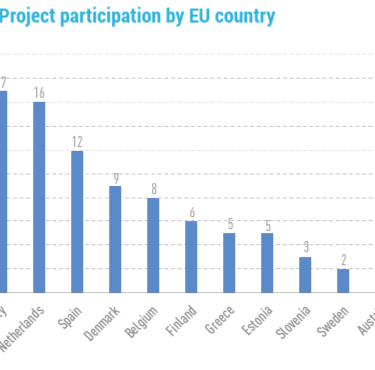
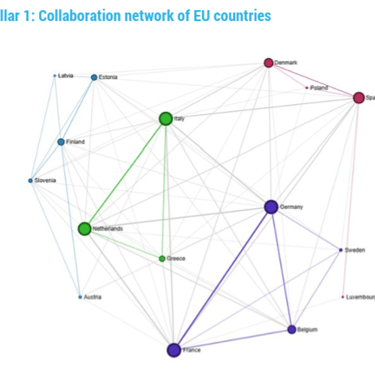
Latvia is not yet a volume player in the review, but it appears in places that matter. In Pillar 1 on renewable hydrogen production, Latvia is listed among the smaller Member States contributing to a single project, while the collaboration network highlights a Baltic-Nordic cluster built around Estonia, Finland, and Latvia. That suggests Latvia is already plugged into a regional innovation pattern rather than acting in isolation.
Latvia is also mentioned in one of the more commercially interesting end-use areas for PtXBaltic: waterborne applications. The report notes that, as part of a HORIZON Mission initiative, a consortium with French, Latvian, and Estonian institutions is developing and demonstrating a hybrid hydrogen-electric 12-metre fishing vessel to be deployed in three countries from 2026. In practical terms, that puts Latvia inside a real maritime decarbonisation test case rather than only in strategy language.
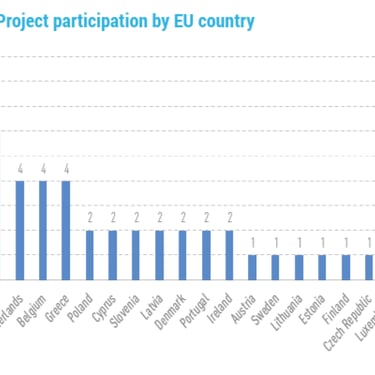
Latvia also appears in Pillar 6 on hydrogen valleys, where the country is shown with one project participation. On top of that, the BalticSeaH2 factsheet states that connected valleys are planned in Latvia, which gives the country a direct pathway into wider Baltic hydrogen ecosystem build-out.
Estonia is visible across research, valleys, and cross-border scale-up
Estonia has one of the strongest Baltic footprints in the report. Like Latvia, it appears in the Pillar 1 Baltic-Nordic collaboration cluster, but its more important role comes through Hydrogen Valleys and strategic research. Estonia is part of the BalticSeaH2 cross-border hydrogen valley with Finland, and the report describes that project as the largest cross-border hydrogen valley in Europe.
The BalticSeaH2 project context is especially relevant for PtXBaltic’s audience because it is not narrow or symbolic. The factsheet points to more than EUR 1.5 billion in investments, Clean Hydrogen JU support of EUR 33 million, target hydrogen production above 5,000 tonnes per year, and value-chain coverage including electrolysis, large-scale refuelling, storage, long-haul trucks, coastal and sea-going vessels, stationary fuel cells, and green ammonia bunkering. That is exactly the kind of integrated platform where Baltic ports, logistics, industry, and maritime fuels can converge.
Estonia also appears in Pillar 8, where it is listed among the countries participating in one of the strategic research challenge projects. That is a useful signal: Estonia is not only present in deployment ecosystems, but also in the earlier-stage research track around critical materials, storage materials, and durability mechanisms.
Lithuania’s signal is strongest in policy readiness and valley linkage
Lithuania is mentioned in a different but still important way. At the national policy level, the report notes that, as of May 2024, Lithuania had published its first hydrogen strategy. For a market still building bankable project pipelines, that is not a minor detail. It means Lithuania has moved from general interest into formal policy positioning inside the European hydrogen landscape.
Lithuania also appears in Pillar 6 with one project participation, and in the BalticSeaH2 future steps section as one of the connected valleys planned alongside Latvia, Poland, Germany, the Nordics, and others. So while Lithuania is less visible in the report’s project narratives than Estonia, it is clearly present in the next layer of Baltic regional hydrogen integration.
What the overall review says about the next Baltic opportunity window
The wider strategic message of the report is clear. Europe is making progress in electrolysers and integrated hydrogen systems, but it still faces durability, efficiency, cost, critical raw material dependence, standardisation gaps, slow regulatory uptake, supply-chain risk, and insufficient exploitation of completed project results. The review also flags transport segments such as maritime, rail, aviation, and heavy-duty applications as areas where much more work is still needed.
For the Baltic states, that combination is highly relevant. It means the region does not need to copy the largest hydrogen markets to become important. It can advance by being precise: build cross-border valleys, focus on maritime and port-side use cases, turn demonstration data into standards-ready evidence, strengthen supply-chain niches, and connect project development with industrial offtake. That is where the report suggests real momentum will come from.
Where Latvia, Estonia, and Lithuania can move fastest in the next years
The report points to five practical lanes where the Baltic states can advance. First, hydrogen valleys should remain the central platform logic, because that is where Europe is concentrating money and where the Baltics already have visibility. Second, maritime hydrogen and e-fuels look especially promising for the region, given the report’s emphasis on harder-to-decarbonise transport and the explicit Latvian-Estonian fisheries vessel demonstration. Third, standards, certification, and regulatory translation need more attention, because the review repeatedly says technology progress is not being converted quickly enough into frameworks that accelerate uptake.
Fourth, supply-chain resilience is becoming a strategic differentiator. The report argues for multiple suppliers, stronger coordination between projects and OEMs, and better handling of delivery risks and component shortages. Fifth, skills and implementation capacity matter more than many project ecosystems admit: the review identifies labour shortages, certification delays, and lack of standardisation among recurring bottlenecks. In a Baltic context, that creates space not only for hydrogen production projects, but for engineering services, digital tools, ports integration, safety competence, and specialised manufacturing niches across the wider PtX value chain.
PtXBaltic takeaway
The Baltic presence in the Clean Hydrogen Partnership review is still emerging, but it is already meaningful. Estonia is visible through cross-border hydrogen valley scale and strategic research, Latvia appears in renewable hydrogen collaboration and maritime demonstration, and Lithuania is now on the board through formal hydrogen strategy development and valley linkage. The next step for the region is not to ask whether it belongs in Europe’s hydrogen transition, but how quickly it can turn these early signals into investable Baltic hydrogen projects, industrial demand, and cross-border PtX ecosystems.
Source: Program review report 2025