Baltic Hydrogen Will Depend on Storage First: What the EU’s Latest Grid Planning Review Means for Lithuania, Estonia and Latvia
The EU’s latest assessment of energy storage planning shows a clear message for the Baltic region: grid flexibility is moving from a technical detail to a strategic competitiveness issue. For PtXBaltic, the report is especially relevant because it shows where Lithuania, Estonia and Latvia are positioning themselves today—and where hydrogen will need stronger links with storage, networks and power-to-X planning to scale.
NEWS
PtXBaltic
4/13/20264 min read
Storage is no longer a side topic in Europe’s energy transition
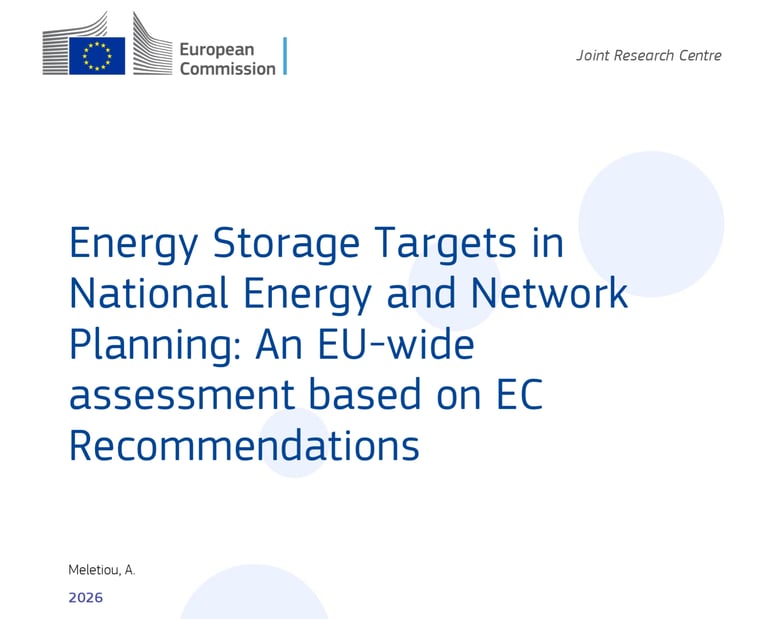
The new JRC assessment reviews all 27 National Energy and Climate Plans, 55 distribution network development plans and 30 transmission network plans, and its main conclusion is blunt: Europe is still uneven in the way it treats storage, flexibility and non-wire alternatives. Storage is increasingly recognised as essential for renewable integration, grid balancing and decarbonisation, but in many member states it still has not been translated into quantified targets or consistent network planning.
That matters well beyond batteries alone. For the wider PtX and hydrogen economy, this is the foundation layer. A power system that cannot absorb variable renewables efficiently will struggle to support electrolysers, flexible industrial demand and new synthetic fuel production. The report’s broader message is that storage policy, network planning and flexibility markets are becoming part of the same strategic conversation.
Hydrogen is mentioned, but it is not yet the main story
Hydrogen does appear in the report, but mostly as one element within a broader flexibility toolbox rather than as the central focus. In the EU policy framing, the report lists green hydrogen alongside batteries and decentralised systems as part of the storage build-out needed for climate neutrality. It also points to cases where hydrogen electrolysis or power-to-X is treated as a flexibility resource, including Denmark’s long-term TSO planning and Slovakia’s qualitative NECP references.
That is an important signal for the Baltic hydrogen sector. The report does not yet present hydrogen as a mainstream planning category in the same way it presents battery storage or pumped hydro. In practical terms, this means Baltic hydrogen developers still need to make a stronger case that hydrogen is not only an industrial decarbonisation option, but also a grid-supporting flexibility asset with value for congestion management, renewable integration and system adequacy.
Lithuania somehow stands out as the Baltic front-runner
Among the three Baltic states, Lithuania has the strongest profile in this report. It is classified among the countries with high normalised operational storage capacity, and its NECP target reaches around 2.51 GW by 2030, made up of 1.50 GW of battery storage and 1.01 GW of pumped storage at Kruonis. That is not a marginal adjustment. It signals that Lithuania sees storage as a structural part of the future power system rather than a pilot-scale add-on.
Just as important, Lithuania’s planning framework looks more mature than its regional peers. The report places Lithuania in the core group of EU countries that combine comprehensive national targets with strong network planning alignment. At distribution level, its DSO quantifies flexibility needs, and the report also notes that flexibility deployment could defer EUR 39–50 million of grid investments. For PtXBaltic readers, that is the real strategic takeaway: Lithuania is not only building storage ambition on paper, it is starting to connect storage with network economics and system planning.
For hydrogen, this creates a stronger platform. A country that is already embedding flexibility into grid planning is better placed to integrate electrolysers intelligently, especially where hydrogen can absorb renewable surpluses, support curtailment reduction and align with broader power-to-X development.
Estonia is moving from a low base toward a clearer scale-up story
Estonia presents a very different picture. The report classifies it as a country with low current storage deployment, with only about 0.04 GW operational and a low normalised storage level. But the forward-looking signal is much stronger: Estonia’s updated NECP aims for around 1 GW of storage capacity by 2030, and the report also notes substantial storage activity in the transmission pipeline, including 1,087 MVA of storage capacity in ongoing connection processes and preparatory work linked to the planned 500 MW Paldiski pumped-storage project.
That combination makes Estonia one of the more interesting Baltic transition stories. It is not yet a storage leader in operational terms, but it is trying to move decisively. The report also places Estonia among the countries with comprehensive TSO-level treatment of flexibility and storage, even if the use of storage as a grid investment alternative remains more exploratory than fully embedded. For hydrogen stakeholders, Estonia looks like a market where the flexibility architecture is forming quickly—and where hydrogen could still shape its role if linked early to grid and renewable integration logic.
Latvia is more cautious, but not without opportunity
Latvia is the most restrained of the three Baltic states in this report. It is classified among the countries with very low current storage deployment, with roughly 0.01 GW operational and only 0.2% in normalised terms. Its NECP is assessed as moderate rather than comprehensive: the plan foresees up to 60 MW of electricity storage in residential and commercial sectors by 2030 and at least two pilot projects in large power plants by 2035, but it does not establish a broad system-wide storage target.
Still, Latvia should not be read only as a lagging case. The report shows a more nuanced position. While the NECP is cautious, Latvia’s transmission planning is stronger: its TSO is classified as comprehensive both for storage/flexibility targets and for considering storage as an alternative to grid investments. That suggests that Latvia may be moving faster at system-operator level than in national political signalling. For PtXBaltic, this is highly relevant. Latvia may still lack a large headline storage target, but the grid planning logic is more advanced than the public narrative might suggest.
For hydrogen, this points to a practical route forward. Latvia’s next step is not only to announce bigger ambitions, but to connect hydrogen and power-to-X more explicitly with storage, flexibility and congestion management in national planning documents. That would turn pilot logic into market logic.
What the Baltic region should take from this report
The strongest strategic message from the JRC assessment is that the next phase of the energy transition will be shaped by who can integrate flexibility into planning, not only who can announce renewable capacity. Europe is moving unevenly, but the pattern is clear: countries that quantify storage needs, integrate them into DSO and TSO plans, and start treating storage as an alternative to traditional grid reinforcement are building a more investable transition framework.
For the Baltics, the regional hierarchy in this report is also clear. Lithuania looks the most system-ready. Estonia looks ambitious and fast-evolving. Latvia still looks cautious at policy level, but with stronger transmission-side signals than its NECP alone would suggest. None of the three is yet presented primarily through a hydrogen lens. That is exactly why this report matters for PtXBaltic: it shows that Baltic hydrogen growth will depend on proving value inside the flexibility and storage agenda, not outside it.
In other words, the next Baltic hydrogen story will not be written by electrolyser announcements alone. It will be written where storage, grid planning, renewable balancing and power-to-X finally start to converge.