Estonia's Electrolyser, Finland's Pilot: A Power-to-X Template the Baltics Should Claim
Finland's Fortum has opened the EUR 20 million Kalla Test Center, running an Estonian-built Stargate Hydrogen alkaline electrolyser beside a Norwegian PEM system. We unpack why this Baltic-engineered, pilot-and-validate model is a Power-to-X template Estonia, Latvia and Lithuania could adopt as the Nordic-Baltic Hydrogen Corridor advances.
NEWS
PtXBaltic
6/1/20265 min read
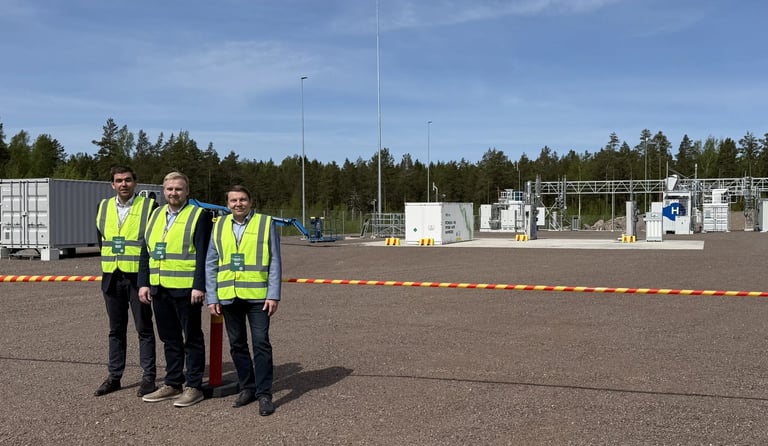
There's a quiet moment that matters more than most ribbon-cuttings in this sector. It happened in Loviisa, a small Finnish town about 90 kilometres east of Helsinki, where the state-owned utility Fortum switched on a EUR 20 million pilot-scale Power-to-X plant called the Kalla Test Center. Most outlets ran the headline as Finland adding a hydrogen site. The detail worth sitting with is different: the electrolyser doing the work was designed and built next door, in Tallinn, by an Estonian company.
That single fact reframes the story for everyone tracking the Baltic PtX value chain. This isn't a distant Nordic project. It's Baltic engineering proving itself at industrial scale, on a real grid, under real operating conditions — and the model behind it maps almost directly onto what Estonia, Latvia and Lithuania will each need as the region moves from hydrogen ambitions toward actual e-fuels, e-methanol and eSAF output.
What Fortum actually built in Loviisa
The Kalla Test Center is a roughly 2 MW pilot facility sited next to Fortum's Loviisa nuclear power plant. It draws electricity from the grid and uses an ordinary household-grade water source to produce hydrogen — deliberately unglamorous inputs, chosen because the point of the site is to learn how the technology behaves when it has to run, not when it's posing for a photo.
Site preparation began in autumn 2024, construction started in summer 2025, and the plant produced its first hydrogen during commissioning in December 2025. Full operation is expected in summer 2026. Fortum has framed it plainly: the centre exists to build the practical experience needed to develop hydrogen and industrial decarbonisation solutions, and it will serve as a platform for operational learning, technology validation, and future project development through 2028.
One figure worth verifying directly: most coverage describes Kalla as around 2 MW total capacity, with the alkaline unit rated at 1 MW. Anyone citing exact numbers should confirm them against Fortum's own release — the reporting is broadly consistent, but the rounding varies between sources.
The two-technology bet — the part most readers skipped
Here's the design choice that makes Kalla genuinely useful. It runs two different electrolyser technologies side by side. The first is a 1 MW alkaline system from Estonia's Stargate Hydrogen, which produced the site's first hydrogen in December. The second, less reported in the regional press, is a roughly 750 kW PEM system from Norway's Hystar. Fortum's vice-president for P2X and project execution, Satu Sipola, called the move from commissioning into structured testing a critical step, with the stated aim of comparing performance, flexibility, durability and scalability across alkaline and PEM under identical real-world conditions.
Why does that matter to the PtX community specifically? Because almost every Power-to-X project faces the same fork in the road — alkaline or PEM — and most of the evidence available today comes from vendor datasheets and lab benches. A neutral operator running both chemistries on the same grid connection, with the same water, the same weather and the same operating team, generates the kind of comparative data nobody can buy off the shelf. That's the real asset being created in Loviisa. The hydrogen is almost a by-product.
Baltic engineering, validated at scale
Stargate Hydrogen is a Tallinn company founded in the early 2020s, manufacturing alkaline electrolyser stacks built around a ceramic, precious-metal-free catalyst — an approach designed to cut both capital cost and energy consumption. In 2025 it opened a Tallinn factory with a first-phase capacity of around 140 MW of electrolysers per year, scalable past 1 GW, and it holds IPCEI status (Important Projects of Common European Interest). Its customer base already reaches across Europe and into the Middle East, Türkiye and India.
Its CEO, Marko Virkebau, said the inauguration proves the company has reached the maturity level required to be trusted by large industries, and that delivering the project with Fortum shows its technology and team are ready to support the growing hydrogen economy in the Nordics and beyond. Read through a regional lens, the signal is unmistakable: a Baltic manufacturer is now supplying serious PtX infrastructure to a Nordic state utility. The supply chain the region keeps talking about building already has a working anchor 300 kilometres up the coast.
From a single electrolyser to the full PtX chain
It's worth being precise about why a hydrogen pilot belongs on a Power-to-X platform's radar. Kalla sits inside Fortum's P2X division for a reason: the electrolyser is only the first conversion step. Everything downstream — e-methanol, e-ammonia, eSAF for aviation, synthetic fuels for hard-to-abate transport — depends on green hydrogen that is reliable, cost-controlled and produced at predictable load. Validating the electrolysis layer under real conditions is what de-risks every product that sits on top of it.
That's the link the Baltic PtX developers should draw explicitly. The region's emerging eSAF and e-methanol ambitions, the corridor infrastructure, the offtake conversations all assume a trustworthy hydrogen base layer. Loviisa is, in effect, a public stress-test of that base layer using equipment built in the Baltics. The findings — which chemistry holds up, how each behaves under variable load, where the cost curves actually land — are inputs the whole downstream value chain can use, regardless of which Baltic state ends up hosting the production.
Why the Kalla model fits the Baltic PtX ecosystem
The instinct in smaller markets is to wait for someone bigger to de-risk the technology first. Kalla suggests a smarter posture: become the place where the de-risking happens. A pilot-and-validate site is far cheaper than a full commercial plant, it produces commercial intelligence the entire ecosystem can use, and it builds the one thing that can't be imported — hands-on operational know-how.
The region already holds the raw ingredients. The Nordic-Baltic Hydrogen Corridor runs through Estonia, Latvia, Lithuania and Poland and carries EU Project of Common Interest status. Conexus Baltic Grid is mapping the infrastructure question for Latvia. Projects such as CIS Liepāja are structuring serious volumes, and regional eSAF initiatives are taking shape. What's been missing is a neutral, operator-grade testbed where developers, OEMs and investors can watch competing technologies perform before committing capital to a final investment decision.
For Baltic PtX ecosystem stakeholders, the takeaway is twofold. First, a regional electrolyser supply chain is no longer aspirational — it's shipping product across borders. Second, the pilot-then-scale sequence Fortum chose is one a market the size of any single Baltic state can realistically run, and arguably should, before the corridor's commercial wave arrives rather than after it.
The window that's open right now
Finland has just shown that you don't need to be a hydrogen superpower to build credible PtX capability — you need a willing utility, a clear-eyed pilot and the discipline to learn in public. The technology to do it is being manufactured in the Baltics today. The corridor that would carry the molecules already has EU backing. The missing piece is a Baltic decision to host the learning rather than import it later at a premium.
Kalla won't be the last facility of its kind in this neighbourhood. The open question is which Baltic postcode the next one carries.
Source: Fortum inaugurates hydrogen production test facility in Finland with Stargate Hydrogen’s technology.