Introducing the Baltic Technology Spotlight — First Feature: HydroQell
PtXBaltic is launching a recurring Baltic Technology Spotlight to track the hydrogen technologies being built in the region — not just the projects deploying them. We open the series with HydroQell, a dual-chamber hydraulic hydrogen compressor in EU-funded lab validation at Ventspils University of Applied Sciences.
NEWSINNOVATIONS
PtXBaltic
7/10/20264 min read
While still challenged by high costs and uneven availability, green hydrogen is an increasingly viable route to decarbonising transport and industry across the Baltics — and most of the attention, ours included, goes to projects: electrolyser plants, refuelling pilots, corridor studies, valley consortia. What gets far less coverage is the layer underneath all of it — the technology itself, and the Baltic teams building it. From today, we are changing that.
A new fixture on PtXBaltic: the Baltic Technology Spotlight
You will notice a new section on our homepage: the Baltic Technology Spotlight. It features one technology at a time — a compressor, a coating, a stack, a material — emerging from the Baltic hydrogen and Power-to-X value chain, from university laboratories and deeptech ventures to industrial deployment. Each edition pairs the homepage feature with an article like this one, and rotates when there is something real to report: a test stand commissioned, a patent granted, a pilot signed. Not on a marketing calendar.
As with everything we publish, the spotlight is based on public sources and our own industry insight, and we will keep the caveats attached. Early-stage technology deserves coverage precisely because it is early — but that only works if modelled numbers are labelled as modelled and technology readiness levels are stated plainly. That is the editorial standard for this series.
The playing field is forming — and the numbers say so
Why launch this now? Because the ground has shifted. The latest Baltic Deep Tech Report counted roughly €328 million invested across 106 deep-tech funding rounds in the Baltics in 2025 — up 160% on 2020 — with deep tech accounting for about 49% of all tech investment in the region, and energy among the fastest-growing verticals. These are publicly announced deals only, so the real figure is likely higher.
Hydrogen technology is visibly part of that wave. Estonia's PowerUp Technologies raised €10 million for its hydrogen fuel cell scale-up. Latvia's Naco Technologies is building nanocoatings that cut precious-metal use in hydrogen equipment. We have covered Stargate Hydrogen taking its precious-metal-free alkaline stacks into European industrial projects through the Hydrogenera framework deal, and the PUR4LH2 team in Riga pointing Ariane-6 cryogenic insulation heritage at hydrogen aviation. The pattern is consistent: the Baltics are not only hosting hydrogen projects — they are building hydrogen technology.
Why component innovation is the hinge for hydrogen in Europe
Europe's hydrogen strategy lives or dies on cost. The valleys and corridors — BalticSeaH2 with its 40 partners across nine countries, HRS recently established in the Tallinn (Estonia) and Klaipeda (Lithuania), Vilnius (Lithuania) commissioning its first hydrogen bus fleet — create the demand pull. But whether the economics close is decided at component level: how efficient the stack is, how much energy compression eats, how well storage holds. Every percentage point of hardware improvement flows straight into the delivered price of hydrogen, and into whether a station or plant is bankable.
This is where a small region can matter disproportionately. The Baltics will not out-build Germany on gigawatt project volume — but a laboratory in Ventspils, Riga or Tallinn can absolutely produce the component that changes a cost curve. That is the thesis of this series.
First in the spotlight: HydroQell / HYCODUQ
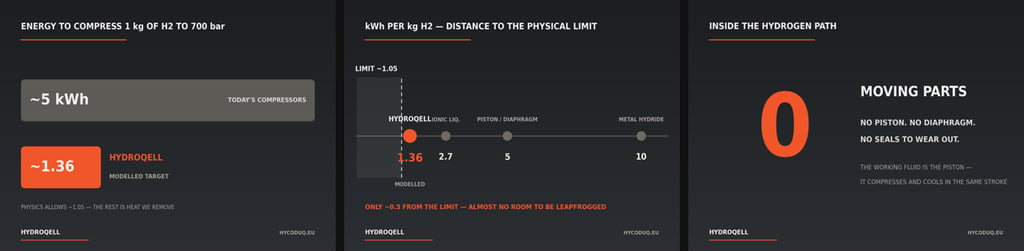
Our inaugural feature comes from Ventspils University of Applied Sciences, where the HYCODUQ project is developing HydroQell — a dual-chamber hydraulic hydrogen compressor. The problem it attacks is one every refuelling station operator knows: compressing hydrogen heats it, and that heat is wasted energy, oversized cooling, mechanical stress and downtime. Today's diaphragm and piston compressors consume roughly 5 kWh to bring one kilogram of hydrogen to 700 bar, while thermodynamics says about 1 kWh should suffice.
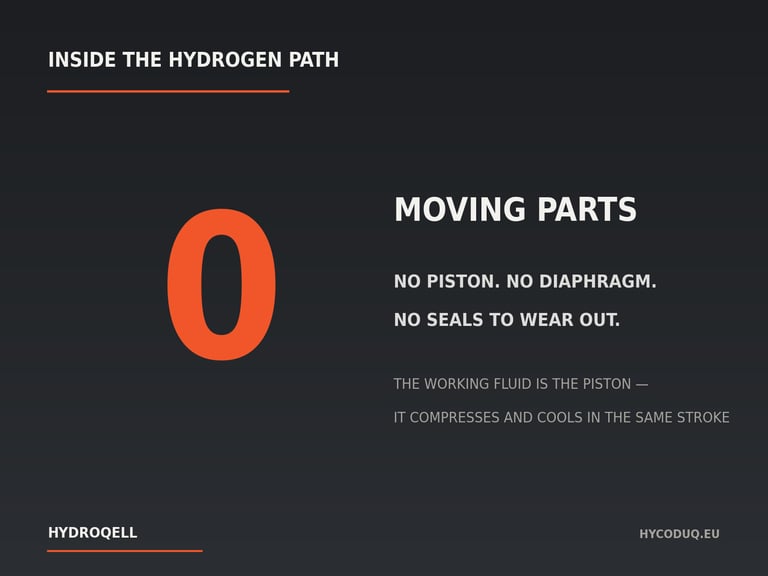
HydroQell's answer is to remove the heat during the stroke rather than after it. In its dual-chamber layout, tangentially injected working fluid — silicone oil enhanced with carbon nanomaterials — acts as the piston itself, cooling the gas as it compresses. There is no mechanical piston, diaphragm or seal in the hydrogen path, and the architecture tolerates variable inlet pressure, which is what electrolyzers actually deliver.
The numbers, honestly labelled
The headline figure is a target energy consumption of ~1.36 kWh/kg at 70 MPa. Two things about that number, stated the way we intend to state such things throughout this series. First, it is a CFD-modelled target, not a measured result — the EU-funded laboratory validation programme (TRL 2→3) runs through late 2026, and that is exactly what the current project exists to test. Second, the comparison benchmarks — around 5 kWh/kg for reciprocating piston and diaphragm units, 2.7 for ionic liquid systems, 10 for metal hydride — come from the peer-reviewed literature (Pereira et al., 2024, Energies 17, 4906), not from the project's own marketing. If the modelled figure survives lab validation, it would sit only ~0.3 kWh/kg above the theoretical isothermal minimum.
Proof beyond the model
What makes this more than a simulation story is the paper trail. The team's European patent EP4352368B1 was granted in 2025, on top of three Latvian patents, PCT filings and five peer-reviewed publications. Most tellingly, French refuelling-station manufacturer Atawey — one of Europe's leading HRS builders — acquired two of the team's prior-generation patents in 2024. An OEM paying for the IP is the strongest external validation an early-TRL technology can show.
The team is currently defining the benchmark criteria and pilot specification for the next-generation unit together with industry, and is inviting refuelling-station builders, electrolyzer system integrators and hydrogen storage operators into that conversation. Baltic hydrogen ecosystem stakeholders who want the full technical picture will find it at hycoduq.eu.
What comes next in the series
The spotlight will rotate as Baltic technologies hit real milestones — and there is no shortage of candidates, from materials science in Riga to electrolyser manufacturing in Tallinn and the hydrogen valley work taking shape around Panevėžys. If you are building hydrogen or Power-to-X technology in the Baltics and believe it belongs in this series, we want to hear from you at info@ptxbaltic.eu.
What to take from it
Projects make headlines; technology makes projects viable. The Baltic deep-tech numbers show a region that has quietly built the investment base, the academic depth and the first commercial proof points to matter in hydrogen hardware. This series exists to make that visible — one technology at a time, with the caveats kept on. HydroQell, with its granted EU patent, an OEM already buying into the team's IP, and a validation campaign running through 2026, is exactly the right place to start.
Source: HYCODUQ — HydroQell dual-chamber hydraulic hydrogen compression