
Cryogenic Insulation for Hydrogen Aviation: A Baltic Deeptech Case | PtXBaltic
Latvia's PUR4LH2 project is developing low-GWP polyurethane foam to insulate liquid hydrogen aircraft tanks — proof that Baltic deeptech materials innovation belongs in the hydrogen aviation value chain.
NEWS
PtXBaltic
6/26/20265 min read
The unglamorous problem standing between hydrogen and flight
When people picture hydrogen aviation, they picture the engine — the fuel cell, the propeller, the moment the aircraft lifts off with nothing but water vapour behind it. But the harder question sits one layer down, and it's a materials question: how do you keep liquid hydrogen at roughly –253 °C inside a tank that has to fly, take mechanical load, and stay certifiable for two decades?
Get that wrong and the physics turns against you fast. Even a small heat leak into an LH₂ tank means boil-off — fuel turning to gas, mass lost, pressure rising, and a fresh set of safety and certification problems to solve. The reference boil-off rates engineers design around for cryogenic tanks sit in the order of a fraction of a percent per day, and on an aircraft every gram and every watt of heat ingress counts twice. So before hydrogen flies commercially, somebody has to build insulation that's genuinely up to the job.
That somebody, increasingly, includes a lab in Riga.
A Latvian materials project aimed straight at the LH₂ tank
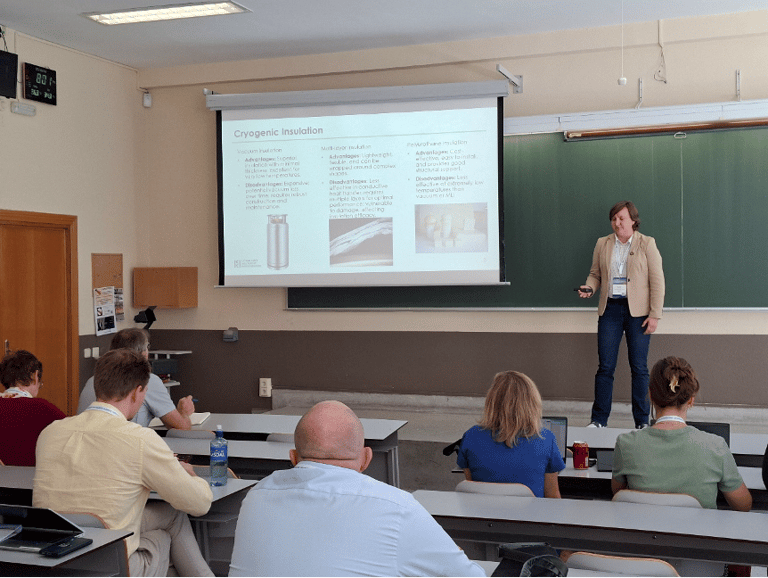
The project is called PUR4LH2 — short for rigid polyurethane foam as cryogenic insulation for future zero-emission commercial aircraft. It runs in the Polymer Laboratory of the Latvian State Institute of Wood Chemistry (LVKĶI), led by Dr. Vladimirs Jakušins, with a team including Dr. Uģis Cābulis, Laima Vēvere and Vanesa Dhalivala. The brief is specific: develop a rigid polyurethane foam composition that can insulate liquid hydrogen tanks for the next generation of zero-emission aircraft, hold up for at least 20 years, and meet aviation safety and qualification requirements.
What makes this more than an incremental materials study is the chemistry underneath it. The LVKĶI foam compositions are built on polyols derived from renewable feedstock — in the laboratory's longer body of work, that has meant tall oil fatty acids, a side stream of wood pulping that doesn't compete with food or feed, alongside recycled PET. The catalysts are heavy-metal-free, and the blowing agents are next-generation ones with low global warming potential. That's not a marketing flourish. It's a design choice that keeps the material on the right side of the EU's tightening F-gas Regulation (2024/573), which phases down high-GWP fluorinated gases across the bloc and brings insulation foams into scope around 2033. A cryogenic insulation designed today on low-GWP chemistry is a material that doesn't need re-engineering the moment the regulation bites.
From 70 formulations to six, and what the first year actually produced
The detail worth holding onto — the thing that separates a real engineering programme from a press release — is the funnel. In the first project year, the team screened 70 polyurethane systems in the lab and narrowed them to six for further optimisation at pilot scale. The next phase moves into long-term ageing tests and repeated cryogenic cycling, to see whether the material stays stable across the kind of service life an aircraft demands.
That progression matters because aviation doesn't reward a foam that performs once. It rewards a foam whose behaviour you can predict over thousands of fill-and-empty cycles, under thermal contraction loads, with moisture trying to creep in under steep temperature gradients. The PUR4LH2 plan tests not just thermal conductivity and mechanical strength but hydrogen permeability and moisture uptake — the failure modes that quietly degrade cryogenic insulation over years rather than minutes. The stated aim is "qualification-grade" data: results that aviation companies and certification bodies can actually use, against the certification roadmaps that EASA and the FAA have both published for hydrogen aircraft.
While still challenged by high costs and low availability, green hydrogen is an increasingly viable route to decarbonising hard-to-abate sectors — and aviation is the hardest of them. Work like this is part of what closes the gap between viable in principle and certifiable in practice.
This is deeptech, and it's happening in the Baltics
Here's the part Baltic hydrogen ecosystem stakeholders should sit with. The value chain for hydrogen aviation isn't only the aircraft makers and the airlines. It runs all the way down to the people who decide what a tank wall is made of. And on that layer — cryogenic materials science — there is real, demonstrated Baltic competence.
This isn't competence built from nothing. The same Riga laboratory developed cryogenic insulation that flew on the European launcher Ariane 6, work LTV recognised as one of Latvia's most significant scientific achievements of 2024. PUR4LH2 takes that space-grade heritage and points it at civil aviation. There's also a clear cross-border thread: the laboratory's cryogenic foam research has been done alongside partners including the Cracow University of Technology and Riga Technical University, and the team is plugged into European cryogenics training networks and conferences. In other words, a Baltic institution sitting inside the international web that's solving hydrogen aviation — not watching from outside it.
That's the headline, and it's an honest one. Deeptech materials innovation contributing to the hydrogen technology value chain is taking place in the Baltic states, not only in the large aerospace clusters of Western Europe. PUR4LH2 is an exemplary case of it.
Why the region needs more projects like this, not fewer
It would be easy to treat PUR4LH2 as a nice one-off. That would be the wrong read.
The honest context is sobering: hydrogen aviation's timelines have stretched. Airbus has pushed its ZEROe entry-into-service from 2035 toward the 2040–2045 window, citing slower-than-hoped progress on the hydrogen ecosystem — infrastructure, production, distribution, regulation. The European aviation roadmap has trimmed how much it expects hydrogen aircraft to contribute to 2050 targets. Anyone selling near-term hydrogen flight is selling optimism.
But here's why that strengthens the case for projects like PUR4LH2 rather than weakening it. The enabling technologies — the tanks, the insulation, the distribution systems — are exactly the long-lead items that have to mature before an aircraft programme can move. Cryogenic insulation isn't a niche component you bolt on at the end. Without reliable, predictable insulation, there's no safe flight operation and no fuelling infrastructure to build around it. And the same insulation systems that serve aircraft tanks also serve airport storage terminals and refuelling infrastructure — the ground-side build-out that has to exist whether the first commercial hydrogen aircraft flies in 2040 or later.
So the region has a genuine opening. The Baltic states carry a deep R&D and academic knowledge base in materials chemistry, cryogenics and polymer science — and PUR4LH2 shows that base producing qualification-relevant results, not just papers. The opportunity now is to build more projects and associated pilots on top of it: scaling cryogenic materials work from lab to pilot, connecting it to the region's port and airport infrastructure ambitions, and pulling Baltic research groups into more of the European consortia where hydrogen's enabling technologies are being qualified. The knowledge base is here. The challenge is to fund and pilot enough of it to turn isolated excellence into an industrial position.
What to take from it
PUR4LH2 is a small project against a very large problem. But it demonstrates something the Baltic hydrogen story often underplays: this region isn't only a place where hydrogen might be produced, moved and consumed. It's a place where the deeptech materials that make hydrogen usable are being invented. That's a more durable position than hosting a pipeline — it's owning a piece of the technology itself.
For everyone working to build a Baltic hydrogen economy, the message is simple. The talent and the science are already here. What we need more of is the willingness to back it — with pilots, with consortium seats, with the patient capital that turns a promising foam in a Riga laboratory into a certified part of the hydrogen aviation value chain.