EastInvest, grid resilience and hydrogen corridors move into the Baltic investment mainstream
A new EU support push for eastern border regions is turning security, grid resilience and hydrogen infrastructure into one strategic investment agenda for the Baltics. For PtXBaltic readers, the key signal is clear: EastInvest, Baltic grid reinforcement and the Nordic-Baltic Hydrogen Corridor are starting to create a more credible platform for bankable PtX and hydrogen projects in Latvia, Lithuania and Estonia.
NEWS
PtXBaltic
4/15/20264 min read
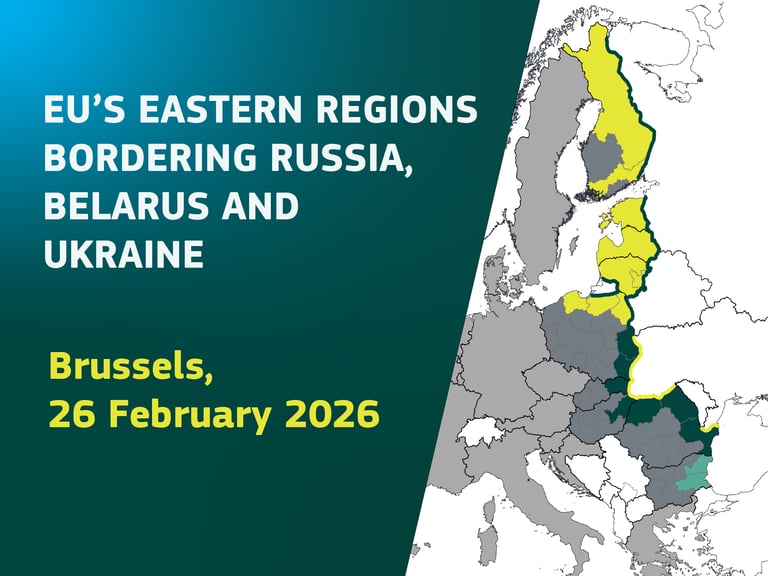
What looked at first like a regional resilience package is, in practice, also an industrial and energy transition signal for the Baltic Sea region. The European Commission’s February 2026 strategy for EU regions bordering Russia, Belarus and Ukraine puts security, competitiveness, infrastructure and local economic resilience into one policy frame, and it explicitly brings Baltic grid integration and cross-border hydrogen infrastructure into that conversation.
For PtXBaltic, that matters. This is not just another cohesion-policy announcement. It is a sign that the EU increasingly sees the eastern flank not only as a geopolitical buffer, but as a build-out zone for strategic energy, transport and industrial assets that strengthen Europe’s resilience while creating room for new business activity in the Baltics and along the wider eastern corridor. That reading is an inference from the Commission’s own priorities around security, growth, energy systems, connectivity and industrial transformation.
A financing platform with strategic implications
At the centre of the package is the new EastInvest Facility, a dedicated financing platform for the nine EU Member States most affected on the eastern border: Finland, Estonia, Latvia, Lithuania, Poland, Slovakia, Hungary, Romania and Bulgaria. The facility brings together the EIB Group, EBRD, Nordic Investment Bank, Council of Europe Development Bank and national promotional banks, with an ambition to mobilise at least €28 billion in private and public investment in 2026–2027, alongside advisory support for project promoters and local public authorities.
That point is important for project developers and regional stakeholders in the Baltics. EastInvest is not a narrow hydrogen subsidy instrument. It is better understood as a de-risking and project-pipeline platform that can improve access to lending, coordination and advisory support for infrastructure, industrial modernisation and regional growth projects in affected territories. The Commission also signalled a review of State aid settings in 2026 and the possible continuation of flexibilities for STEP technologies beyond 2027, which adds another layer of relevance for capital-intensive clean tech and industrial transition projects.
Grid integration comes before large-scale hydrogen
One of the clearest messages in the Commission communication is that the eastern border regions need stronger electricity networks, better grid flexibility, more interconnectors, storage and faster renewable integration. The text is especially direct on the Baltic context: after the Baltic states synchronised with the Continental European Network on 9 February 2025, the next step is to reinforce resilience, upgrade infrastructure and improve integration with the wider EU electricity market.
This sequencing is exactly how serious PtX markets are built. Electrolysers, e-fuels and hydrogen derivatives do not scale on policy ambition alone; they scale on the back of robust grids, credible renewable build-out, predictable transmission planning and cross-border infrastructure. The Commission’s wording therefore matters because it puts the enabling layer first, and that increases the credibility of later hydrogen demand and supply investments across the Baltics. That last point is an inference based on the Commission’s grid and infrastructure priorities.
Hydrogen corridors are no longer peripheral
The hydrogen angle is not buried in the footnotes. The Commission communication explicitly refers to reinforcing cross-border hydrogen infrastructure such as the Nordic-Baltic Hydrogen Corridor through the Baltic Energy Market Interconnection Plan (BEMIP). BEMIP already lists the corridor as one of the Baltic Sea region’s hydrogen Projects of Common Interest, alongside the Nordic Hydrogen Route and the Baltic Sea Hydrogen Collector.
That is a meaningful shift for the Baltic hydrogen narrative. The Nordic-Baltic Hydrogen Corridor is no longer just a long-range concept attached to future decarbonisation scenarios. According to the participating transmission system operators, the corridor is being developed across Finland, Estonia, Latvia, Lithuania, Poland and Germany, it has EU PCI status, it secured €6.8 million of CEF support for feasibility work, and in early 2026 it opened a non-binding Call for Interest to gather market signals on production, consumption, storage, distribution and cross-border transmission needs. Project materials describe a corridor of roughly 2,500 km, with feasibility work continuing until 2027 and commercial operation targeted for the first half of the 2030s.
For Baltic stakeholders, this is where the story becomes commercially relevant. Once a corridor moves into market screening and feasibility, the discussion shifts from abstract policy support to routing, offtake logic, connection points, storage options, industrial clustering and long-term utilisation. That is the phase where ports, heavy industry, utilities, developers and regional authorities need to decide whether they want to shape the corridor or simply react to it later. This is an inference from the project’s Call for Interest and feasibility stage.
A wider PtX window than hydrogen alone
Another underappreciated element of the Commission’s approach is that it does not frame eastern border development around hydrogen only. The communication also points to the role of biomass, bioeconomy, biogas, biomethane, district heating upgrades and feedstocks relevant for ReFuelEU Aviation and FuelEU Maritime. In other words, the Baltic opportunity is broader than a single hydrogen pipeline narrative; it is about building a more resilient regional platform for molecules, fuels, power and industry together.
That broader framing fits the Baltic reality well. In this region, bankable PtX projects will often depend on combinations rather than single assets: renewable power plus grid reinforcement, hydrogen plus industrial offtake, ports plus bunkering logic, biomethane plus local circular economy, and synthetic fuels plus stronger transport connectivity. The Commission’s eastern border strategy gives those combinations a more favourable strategic backdrop because it links them to resilience, competitiveness and territorial cohesion rather than treating them as stand-alone climate projects. This is an interpretation grounded in the Commission’s multi-sector package.
What this means for the Baltics
For Latvia, the signal is particularly relevant. The country sits inside the geography of the eastern-border support package, inside the BEMIP framework, and inside the route logic of the Nordic-Baltic Hydrogen Corridor. That does not automatically create projects, but it improves the policy narrative around why Baltic energy infrastructure, hydrogen transport, renewable integration and industrial conversion deserve to be taken seriously by investors and European institutions.
The practical conclusion for Baltic market actors is straightforward. Project positioning should now be framed not only around decarbonisation, but around energy security, infrastructure resilience, industrial competitiveness, regional retention of economic activity and cross-border integration. Those are the themes now carrying political weight in Brussels, and they are increasingly the language through which future lending, advisory support and enabling infrastructure decisions will be justified. That is an inference from the Commission communication and the EastInvest design.
For PtXBaltic, the bigger takeaway is this: the Baltic hydrogen and PtX story is starting to mature from ambition into corridor logic. When the EU begins to connect security, grids, transport, industrial renewal and hydrogen infrastructure in the same policy package, the region moves one step closer to a market where large-scale projects can be structured on firmer ground.
Source: New platform to boost support for EU regions most affected by the war in Ukraine