
Fourth Estonia-Latvia Interconnector Opens Room for Baltic PtX
A new feasibility study confirms the fourth Estonia-Latvia electricity interconnector is technically sound, offshore, and buildable, and it happens to make landfall almost exactly where ELWIND's offshore wind farm and the Freeport of Ventspils' PurpleGreen ammonia project are already taking shape. We look at what tighter grid capacity between Saaremaa and Kurzeme could mean for Baltic hydrogen and Power-to-X development.
NEWS
PtXBaltic
7/23/20265 min read
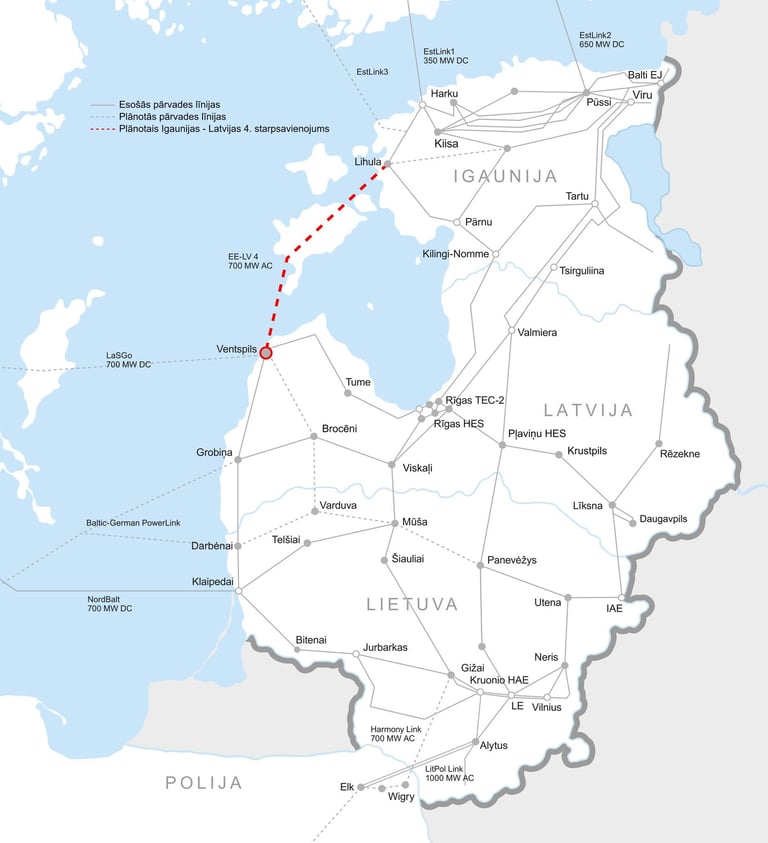
While still challenged by high costs and long lead times, Power-to-X is becoming a genuinely plausible growth story for the Baltic states — but only if the grid underneath it can carry the load. That is why a quietly technical announcement from Latvia's transmission system operator, Augstsprieguma tīkls (AST), and Estonia's Elering deserves more attention from Baltic hydrogen ecosystem stakeholders than its headline suggests. A new feasibility study confirms that a fourth Estonia–Latvia electricity interconnector is technically sound, offshore, and buildable. More interesting still: it makes landfall almost exactly where the region's biggest renewable and Power-to-X bets are already being placed.
A fourth line, roughly 100 kilometres offshore
The study, carried out by Italian energy consultant CESI S.p.A. for AST and Elering, proposes a 275 kV alternating-current double-circuit connection running approximately 100 kilometres between Saaremaa Island in Estonia and the Kurzeme coast in Latvia, with a short, fully undergrounded onshore stretch on each side. The link, known as EE-LV4, would add an estimated 700 MW of transfer capacity between the two power systems — roughly on the same order as the capacity already carried by the existing EstLink and Baltic interconnections combined into the Latvian-Estonian corridor.
Environmental impact assessment work has already started in both countries. Assuming that process runs to plan, AST and Elering are targeting construction after 2030 and commissioning in 2035, financed in part through the EU's Connecting Europe Facility. It is being built alongside, not instead of, reinforcement work each TSO is already doing on its own grid: AST is finalising the EIA for a new 330 kV Ventspils–Brocēni–Varduva line in Latvia, while Elering is planning a new 330 kV line on Saaremaa itself. AST and Elering signed the memorandum of understanding behind the project back in October 2023.
The same coastline is where the region's offshore wind ambitions sit
Here is the detail that makes this more than a routine grid-strengthening story. The Kurzeme coast between Ventspils and Liepāja is also one half of ELWIND, the joint Estonian-Latvian offshore wind development the two governments have been advancing since a 2020 memorandum of understanding, with the Estonian side sited in the sea west of Sõrve. ELWIND's own numbers have moved around as planning has matured — public reporting has referenced a range from roughly 700 MW up toward the 1 GW originally floated — and I'd flag that the project is still working through pre-FEED engineering and environmental assessment rather than a final investment decision, with a development-rights tender expected later this decade.
In other words, the wind resource the Baltics are counting on to feed future electrolysers and the grid corridor that would let it move efficiently between Estonia and Latvia are, quite literally, planned for the same stretch of coastline. That is not a coincidence so much as a reflection of where the good wind, the available seabed, and the existing substation infrastructure at Ventspils all happen to overlap.
Why capacity, not just electrons, is what PtX planners actually worry about
"As the share of renewable energy continues to grow, high-capacity interconnections are becoming increasingly important for maintaining the reliability and stability of the power system," AST management board member Arnis Daugulis said when the study was published. His point is worth sitting with: the Baltic power systems are already reasonably well interconnected, but demand for transmission capacity keeps rising, and a fourth Estonia–Latvia link is framed explicitly as something that lets the grid absorb larger volumes of renewable generation and, in AST's words, "create new opportunities for industrial consumption development, based on renewable electricity."
That last phrase is effectively a description of Power-to-X. Electrolysers are large, steady, price-sensitive loads. Whether they get built where the wind actually is, rather than wherever transmission happens to be free, depends on exactly this kind of interconnector and internal reinforcement work. A curtailed wind farm and a stranded electrolyser are two versions of the same underlying problem: not enough wire between the generation and the demand.
Ventspils is already placing a very large bet on that logic
Nowhere in the Baltics is that bet bigger right now than at the Freeport of Ventspils itself, sitting right where the EE-LV4 cable is proposed to come ashore. PurpleGreen Energy has signed a 45-year rights agreement for roughly 10 hectares at the port to build a green ammonia facility built around a 550 MW electrolyser, targeting around 550,000 tonnes of green ammonia a year, with production intended to start in early 2029. The company has reported an intended investment above €1.3 billion and a 20-year offtake agreement with German trading house Select Energy, and the port already has ammonia-handling capacity of 1.5 million tonnes a year plus rail infrastructure able to service up to 250 tank wagons daily.
PurpleGreen 550 MW green ammonia plant in Freeport of Ventspils (Latvia)
The scale is worth flagging on its own terms: PurpleGreen's own figures suggest the plant, once running, could add somewhere in the region of 65–70% to Latvia's total electricity consumption. Numbers of that size are exactly why grid capacity stops being an abstract planning question and becomes the thing that decides whether a project like this gets built on schedule, gets built later than planned, or gets built somewhere else.
The EE-LV4 interconnector at a glance
Route: offshore, Saaremaa (Estonia) to the Kurzeme coast near Ventspils (Latvia), ~100 km, short undergrounded onshore sections
Configuration: 275 kV AC, double circuit
Added capacity: approximately 700 MW
Study author: CESI S.p.A. for AST and Elering
EIA: underway in both countries; implementation planned after 2030
Target commissioning: 2035
Funding route: EU Connecting Europe Facility, pending confirmatio
None of this lines up on the same calendar, and that is worth saying plainly
It would be tidy to say the interconnector, the wind farm, and the ammonia plant are all arriving together. They are not. PurpleGreen is targeting first production in 2029; ELWIND's own timeline points to construction toward the end of this decade and commissioning into the early 2030s at the earliest, still subject to a development-rights tender and final investment decisions; and EE-LV4 itself is not expected in service before 2035, contingent on EIA outcomes and confirmed EU co-financing that has not yet been secured. Read that way, the interconnector is a reinforcement for a corridor that will already be under real load well before the cable is switched on, not a precondition for the first phase of PtX investment there.
What this signals for Baltic PtX
Taken together, these three projects are a useful, concrete illustration of a point that is easy to make in the abstract and harder to see on the ground: PtX development in the Baltics is not just about electrolyser announcements, it is about whether the wires, the wind, and the offtake arrive in roughly the same place at roughly compatible times. Ventspils looks, right now, like the closest thing the region has to that alignment — a port with ammonia infrastructure already in place, a wind resource being planned a few kilometres offshore, and a TSO-backed interconnector study confirming the corridor is technically workable. Baltic hydrogen ecosystem stakeholders watching where the next wave of PtX investment lands would do well to keep an eye on this stretch of coastline, and on whether the funding and permitting for EE-LV4 keeps pace with the ammonia plant that is already under construction planning next to it.