EU Ports Hydrogen Call Signals Stronger Backing for Ports as Hydrogen Hubs
A new EU tender focused on hydrogen in ports is more than a standalone procurement notice. It is a clear policy signal that European ports, including those in the Baltic Sea region, are moving higher on the agenda as future hydrogen and renewable energy hubs.
NEWS
PtXBaltic
4/22/20263 min read
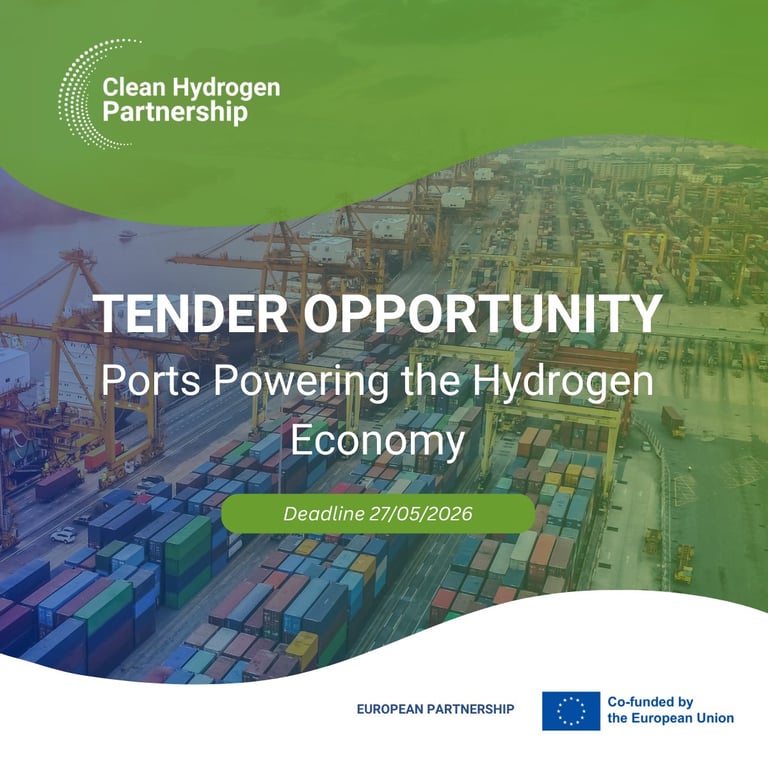
The Clean Hydrogen Partnership has launched a new call for tenders, “Ports Powering the Hydrogen Economy” (CLEANH2/2026/OP/0002), published on 19 April 2026 with a 26 May 2026 deadline. According to the announcement, the tender will procure services to support European ports in exploring and strategically planning the use of hydrogen and its derivatives.
A Practical Step in Europe’s Port Transition
This is not a direct infrastructure subsidy, but it is still an important move. It shows that hydrogen is no longer being treated as a peripheral innovation topic in ports, but as part of mainstream strategic planning for Europe’s maritime, industrial and energy systems.
That direction was already made clear in the EU Ports Strategy, adopted by the European Commission on 4 March 2026. The strategy states that the Commission will promote partnerships for energy cooperation in and around port areas for the sustainable use of energy, including hydrogen. In parallel, the Clean Hydrogen Partnership has underlined that ports are natural entry points for hydrogen and hydrogen carriers into Europe and central to the development of cross-border hydrogen valleys.
Hydrogen and Renewable Energy Are Becoming Core Port Functions
The broader policy framework matters here. Under the Alternative Fuels Infrastructure Regulation, Member States’ national policy frameworks must address the deployment of hydrogen and ammonia refuelling infrastructure in maritime ports, while the latest EU implementation picture also points to maritime ports adopting greener technologies such as onshore power supply, port electrification and ammonia bunkering.
Taken together, that means Europe’s ports are increasingly being shaped not only as logistics gateways, but as integrated energy platforms. The combination of port electrification, clean fuels, hydrogen handling, storage and industrial energy use is gradually becoming part of the same transition pathway.
Why the Baltic Sea Region Stands Out
For Baltic stakeholders, this matters over the longer term because the region already has many of the ingredients needed for hydrogen-based port development. The BEMIP framework covers Denmark, Germany, Estonia, Latvia, Lithuania, Poland, Finland and Sweden, and it explicitly supports regional work on offshore wind, decarbonised gases, hydrogen infrastructure and cross-border interconnections.
The same framework points to a strong build-out trajectory. Baltic Sea countries agreed to increase offshore wind capacity in the sea basin sevenfold by 2030, while BEMIP also highlights three hydrogen Projects of Common Interest relevant to the region: the Nordic Hydrogen Route, the Nordic-Baltic Hydrogen Corridor, and the Baltic Sea Hydrogen Collector. For ports across the Baltic states, this creates a credible long-term foundation for connecting renewable power, hydrogen production, transport, storage and industrial offtake.
There is also already project-level momentum. Clean Hydrogen’s own regional mapping notes that BalticSeaH2 is building a large-scale interregional hydrogen valley across the Baltic Sea region, and that ports are central pieces of hydrogen valley development in Latvia. That is an important reminder that the Baltic discussion is no longer theoretical; the region is already part of Europe’s emerging hydrogen geography.
Longer-Term Opportunities for Baltic Ports
For Baltic state ports, the opportunity is broader than one technology or one fuel stream. The stronger play is to position port areas as places where renewable electricity, hydrogen infrastructure, industrial demand, transport applications and future fuel logistics can be planned together rather than in isolation.
In practical terms, that can mean several parallel pathways: preparing sites for future hydrogen and derivative handling, aligning port development with offshore wind and grid expansion, connecting ports to inland industrial demand, and using port ecosystems as launch points for maritime fuel transition, heavy mobility applications and clean industrial clustering. This is exactly why the latest EU tender matters. It signals that strategic port planning for hydrogen is moving from concept-stage discussion into a more structured European support framework.
A Clear Signal for the Market
The immediate value of this announcement lies in its direction of travel. European institutions are increasingly treating ports as pivotal infrastructure for the hydrogen economy, and the Baltic Sea region is well placed to benefit from that shift thanks to its port network, cross-border energy integration, offshore wind potential and emerging hydrogen corridor logic.
For Baltic port authorities, developers, utilities and industrial partners, the message is increasingly clear: hydrogen planning in ports is no longer a niche exercise. It is becoming part of the wider blueprint for how ports evolve into renewable energy, industrial decarbonisation and clean transport hubs over the coming decade.
Source: X post