Freeport of Riga SAF Project Moves Into a New Milestone at Kundziņsala
A new milestone has started for the SAF project at Kundziņsala in the Freeport of Riga, as the environmental impact assessment procedure has now been formally applied. The development brings a clearer project pathway for a port-based SAF and HVO production case that could strengthen Latvia’s position in Baltic clean fuels and industrial decarbonisation.
NEWS
PtXBaltic
4/17/20263 min read
Environmental Assessment Phase Now Underway
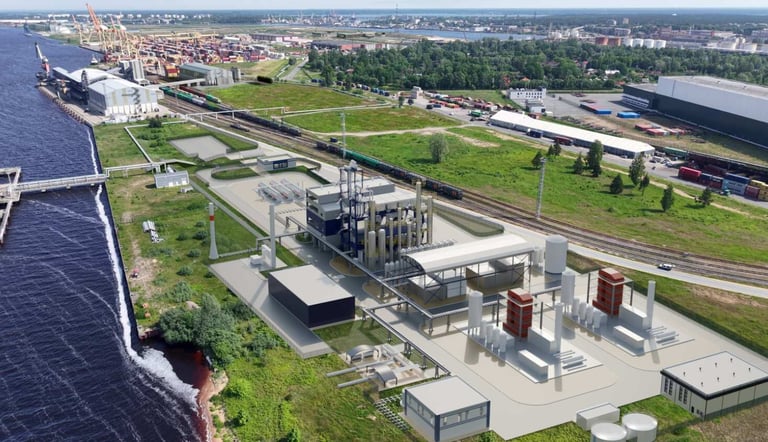
A meaningful next step has now been reached for one of the more important sustainable fuels development cases in Latvia. On 13 April 2026, the State Environmental Service applied the environmental impact assessment procedure to the planned hydrogen production facility and non-hazardous plant- and animal-origin waste processing project proposed by SIA “PARS TERMINĀLS” at Kundziņsala in Riga, with the notice published on 14 April 2026. In practical terms, this means the project has moved into a more advanced development phase, where environmental, technical and implementation parameters will be assessed in greater depth before further decisions are taken.
That matters because this is not just another concept note. It is a concrete port-based industrial case tied to a defined site at Uriekstes iela 30, with planned use of berth KS-28 on Kundziņsala and existing tank infrastructure at Tvaika iela 7A. The combination of waterfront access, storage capacity and multimodal handling is exactly the kind of foundation that gives a fuels project a more credible logistics profile from the outset.
A Port-Based SAF and HVO Production Concept
According to the official project description, the planned facility would produce sustainable aviation fuel, or SAF, together with hydrotreated vegetable oil, also referred to as HVO or renewable diesel, using vegetable oils and hydrogen as core inputs. The notice states that hydrogen supply will be assessed through two alternatives: water electrolysis or production from natural gas and steam. Planned processing capacity is up to 236,000 tonnes of feedstock per year, and the plant is expected to operate continuously for up to 8,400 hours annually.
The same notice also shows why this project deserves closer attention from Baltic stakeholders following SAF, hydrogen and PtX developments. Feedstocks, intermediates and products are expected to move via tanker vessels, road and rail, using existing port and tank infrastructure. That is a commercially relevant detail. In Baltic market conditions, projects that can build on existing terminal and logistics assets often have a more realistic route from concept to execution than cases starting from a blank industrial site.
Why the Timing Matters for the Baltic SAF Market
The broader market backdrop is also becoming more tangible. The EU’s ReFuelEU Aviation framework is designed to increase the share of sustainable aviation fuel supplied at EU airports over time, and the European Commission has stated that the industry is on track for the 2025 target of 2% SAF and progressing toward 6% in 2030. That does not remove project risk, but it does make one point clearer: SAF capacity is no longer a distant policy ambition. It is becoming part of the real industrial build-out that Europe needs over this decade.
There is also a technology logic behind the Kundziņsala case. In Europe, a significant share of SAF scale-up toward 2030 is expected to come through HEFA-type pathways based on oils, fats and waste-based feedstocks. That makes projects built around hydrogen plus lipid-based feedstocks particularly relevant in the current market window, even as the longer-term landscape widens toward synthetic e-fuels and other advanced routes.
What This Means for Riga and for PtX Development in Latvia
For Riga, this milestone signals that the port is not only a logistics node but also a realistic platform for cleaner fuel manufacturing linked to existing industrial infrastructure. For Latvia, it adds another visible case to the wider conversation on hydrogen, renewable fuels, industrial land use and export-oriented energy transition projects. For Baltic stakeholders, the value is equally practical: it offers a live example of how SAF, hydrogen and terminal infrastructure can start converging into a bankable project structure.
We will continue following this development as the assessment process advances and as the project definition becomes clearer. More background on this and other relevant regional cases is available in the PtXBaltic Projects section:
The Amber Flow Fuels 87 kta SAF plant in Freeport of Riga (Latvia)