
HIAD goes public: Europe's hydrogen incident record becomes a tool you can actually use
The Clean Hydrogen Partnership and the European Commission's Joint Research Centre have moved the Hydrogen Incidents and Accidents Database onto a platform built for searching, visualising and downloading. We look at what changed, why a public incident record matters for permitting first-of-kind Baltic projects, and how it reshapes the conversation with municipalities, insurers and financiers.
NEWS
PtXBaltic
7/16/20266 min read
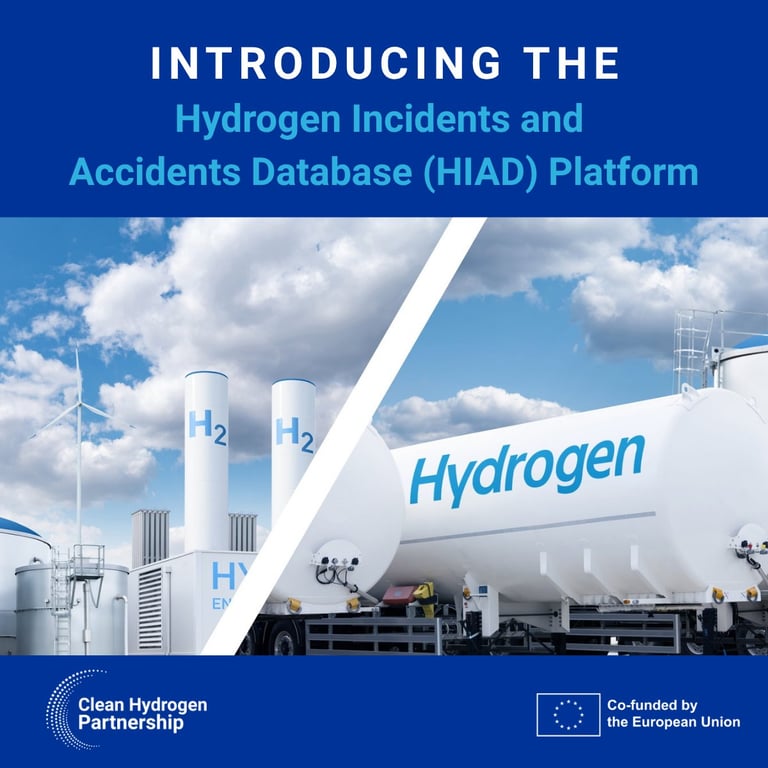
For most of its life, Europe's official record of hydrogen accidents has been something you had to ask for. A spreadsheet, emailed on request. A download buried on a Commission portal that almost nobody outside the safety community had ever visited. The data existed, and it was good data — but getting at it, and doing anything useful with it once you had it, was a project in itself. That has now changed. The Clean Hydrogen Partnership and the European Commission's Joint Research Centre have put the Hydrogen Incidents and Accidents Database — HIAD — onto a platform built for searching, filtering, visualising and downloading. On the surface it reads like a housekeeping update. It isn't.
From a file you request to a record you can query
The new platform does four things: it lets you search and explore hydrogen-related events, download datasets for offline analysis, work through interactive dashboards and visualisations, and reach the scientific publications and safety resources built on top of the data. Anyone who has tried to use HIAD in its previous form will recognise how much of a step that is. The database had been distributed as an Excel file through a JRC portal, with an interactive visualisation tool that sat in beta. It worked, in the sense that a determined safety engineer could get what they needed. It did not work in the sense of a resource that a project developer, a permitting officer or a municipal fire chief would ever stumble across, let alone use on a Tuesday afternoon.
That distinction matters more than it sounds. Safety knowledge that only reaches the people already deep in safety work is knowledge doing half its job. The value of an incident record is highest at the edges of the industry — with the developer building their first electrolyser, the port authority writing its first hydrogen bunkering procedure, the regional authority assessing its first permit application. Those are precisely the people who were never going to email the JRC for a spreadsheet.
Two decades of events, assembled mostly from the public record
HIAD is not new. It came out of HySafe, the EC-funded Network of Excellence on hydrogen safety that ran from 2004 to 2009, and was built by the JRC from around 2006. It was overhauled into HIAD 2.0 in 2017 with support from the FCH 2 Joint Undertaking, and has been maintained and populated by the JRC ever since, working closely with the European Hydrogen Safety Panel. The current EHSP workplan names expanding and analysing the database — now referred to as HIAD 3.0 — as one of its core objectives. So the platform launch is the visible end of a build that has been running for twenty years.
The database holds in the region of seven hundred events, covering accidents, incidents and near misses across the hydrogen supply chain — production, transport by road, rail and pipeline, refuelling, road and non-road vehicles, stationary fuel cells, laboratories, and the petrochemical industry. Almost all of it comes from publicly available primary or secondary sources: news reports, inspection reports from public institutions, scientific literature, and other non-hydrogen-specific accident databases such as France's ARIA, the European eMARS Seveso system, and the US CSB and NTSB. Each entry is validated by the JRC before it goes public, with a quality indicator attached so users can filter on how well an event is actually documented.
The record does not say hydrogen is dangerous
This is the part worth reading carefully, because it is the part most likely to be misused. The JRC's own guidance on HIAD is unusually blunt about it: do not conclude from the data that hydrogen is not safe. Every technology, once deployed at scale, generates unplanned and unwanted events. The database exists to make hydrogen technologies safer, not to build a case against them. It also warns against a blame culture forming around the data — because the moment operators fear the record will be used against them, the sharing stops and the record dies.
What the analysis actually shows is more useful, and more mundane, than the headline anyone might fear. The EHSP's published assessment of the events considered statistically relevant found the dominant contributing factors clustered around a lack of operator training and understanding of hydrogen hazards, poor system design or the use of materials not compatible with hydrogen, and the absence of a functioning system for reporting near misses and learning from them. An overarching finding was that minor events occurring simultaneously could still produce serious consequences — the Swiss cheese model, applied to hydrogen. None of that is exotic physics. It is engineering discipline, materials selection and training. All three are things a project can fix before it builds anything.
Permitting is where a public incident record earns its keep
Across the Baltics, most hydrogen and Power-to-X projects in the pipeline share a common problem that has nothing to do with technology or funding. They are first-of-kind in their municipality. The permitting authority has no precedent to reason from. The regional fire service has no hydrogen call-out in its institutional memory. The environmental assessment has no comparable installation nearby to reference. And in the absence of a shared factual basis, everyone falls back on intuition — which, for hydrogen, tends to be a mixture of the Hindenburg and half-remembered chemistry.
A searchable, public, Commission-validated record changes the shape of that conversation. It gives a developer something concrete to bring to the table: here is what has actually gone wrong with this class of equipment, here is how often, here is what caused it, here is what our design does about each of those causes. It gives the authority on the other side of the table something to check the claim against, from a source that is neither the applicant nor an advocacy group. That is a different kind of exchange than the one most Baltic hydrogen ecosystem stakeholders have been having, and it is a considerably faster one.
One of the JRC's stated long-term aims for HIAD was exactly this — to eventually contribute to facts-based type-approval and permitting. Putting the data where permitting officers can reach it is the precondition for that, and it has only just been met.
Municipalities, insurers and financiers are all asking the same question
The permitting file is only one audience. The same record does work in three other rooms. A municipal council weighing a hydrogen facility near a residential area wants to know what the realistic failure modes look like. An insurer pricing the risk wants a loss history, and a hydrogen-specific one rather than an oil-and-gas proxy. A lender running technical due diligence wants to know whether the sponsor understands its own hazard profile well enough to have designed around it. Every one of them is asking a version of the same question, and until now the honest answer from a Baltic developer was often that the evidence base existed but was awkward to reach.
There is a caveat worth carrying into those rooms. HIAD was never able to deliver on its original ambition of supporting full quantitative risk assessment, because the statistics on faults and failure modes simply were not there — most reports do not contain enough quantitative detail, and only a minority of events carry a proper root cause analysis. So the database is a source of lessons learned and risk communication far more than it is a source of failure rates. Used as the first, it is genuinely powerful. Presented as the second, it will not survive contact with a competent technical adviser.
The gap only the industry itself can close
Here is the honest weakness in the whole structure. HIAD is built almost entirely from public sources, and that is not by design — it is because the private sector has consistently declined to share event information it considers confidential. The JRC has been candid that this is why the risk assessment goal had to be abandoned. Twenty years in, the single largest constraint on Europe's hydrogen safety evidence base is not funding or method. It is that the companies with the best data keep it.
Which makes the platform's framing as a community-driven resource less like marketing and more like a request. The Partnership is explicit that users contributing information on hydrogen-related events strengthen the safety culture the whole sector depends on. For the Baltic ecosystem specifically, where the installed base is small and every operator is learning in public anyway, the calculus is favourable: there is not much competitive advantage in a near-miss at an electrolyser skid, and there is considerable collective value in the next operator not repeating it.
What this signals for the Baltic PtX build-out
While still challenged by high costs and low availability, green hydrogen is an increasingly viable route to decarbonising industrial processes — and the constraint on Baltic projects is shifting away from whether the technology works and toward whether the surrounding system can absorb it. Permits, fire services, insurers, councils, lenders. Every one of those is a conversation about risk conducted by people without a hydrogen reference point, and every one of them is currently slower than it needs to be.
A public, searchable, validated incident record does not solve that on its own. But it moves the argument from assertion to evidence, and it does so for free, in English, from a source that carries the Commission's name. That is worth an hour of any Baltic project developer's time before the next permitting meeting — and worth a serious internal conversation about whether your own near misses should be in there too. The record only stays useful if it keeps growing, and right now it grows mostly from newspapers.
Source: Introducing the Hydrogen Incidents and Accidents Database (HIAD) Platform