Hydrogen for heat: a Baltic-first proof on a live Riga boiler
A working 6.3 MW district-heating boiler in Riga has run on up to 20% hydrogen by volume — no equipment changes, efficiency intact, carbon intensity down. We look at what Rīgas Siltums and Riga Technical University proved, and why a demand sink like this matters for Baltic power-to-X.
NEWS
PtXBaltic
7/21/20265 min read
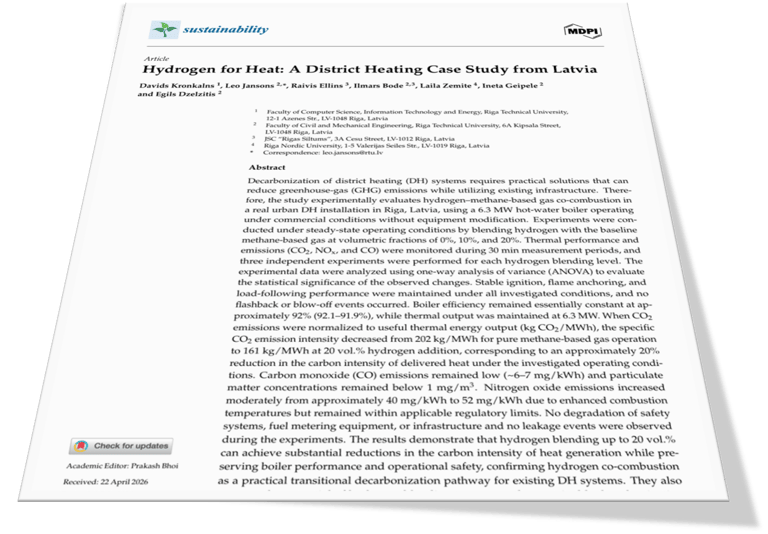
Electricity gets most of the attention in the energy transition, but heat is where a lot of the hard, unglamorous work actually lives. In Latvia, district heating covers somewhere between a third and nine-tenths of the heat supply depending on the town, and much of it still runs on gas. So when a working boiler in Riga quietly ran on a hydrogen blend without anyone swapping out the hardware, it is worth stopping to look at what was proven — and who proved it.
A working boiler, not a simulation
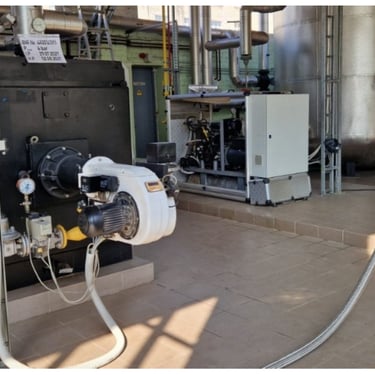
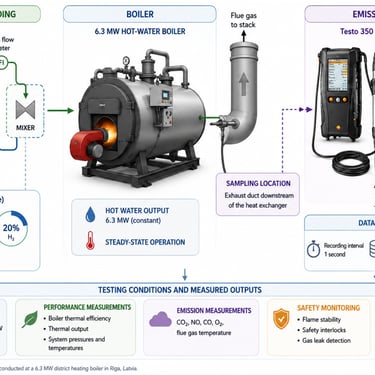
Most of what we know about hydrogen blending comes from laboratories, test rigs and computer models. This was different. A team from Riga Technical University, Rīgas Siltums and Riga Nordic University ran the experiment on a live 6.3 MW hot-water boiler at a Rīgas Siltums plant on the right bank of the Daugava, under normal commercial operating conditions.
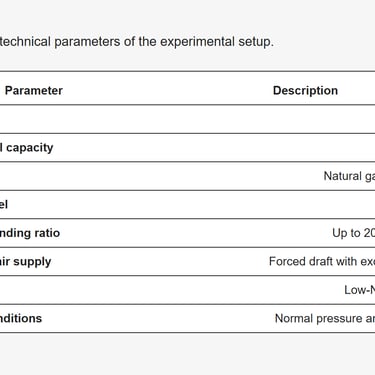
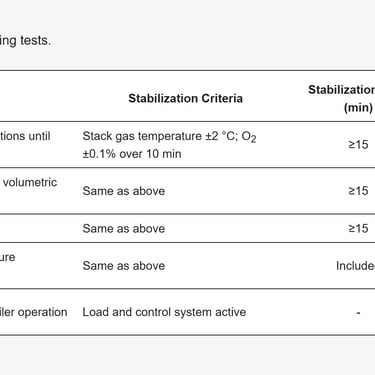
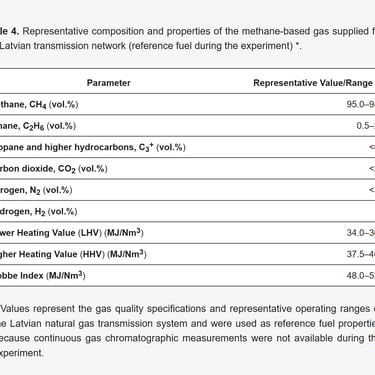
They fed the boiler three fuel blends — pure methane-based gas, then 10% hydrogen by volume, then 20% — with no modification to the burner, the metering or the infrastructure. Each condition was held at steady state, measured over 30-minute periods, repeated three times, and run through statistical analysis. That combination — full commercial scale, real grid gas, zero retrofit — is exactly what has been missing from most of the published evidence, and it is what makes this a reference other operators can point to.
What the boiler actually did
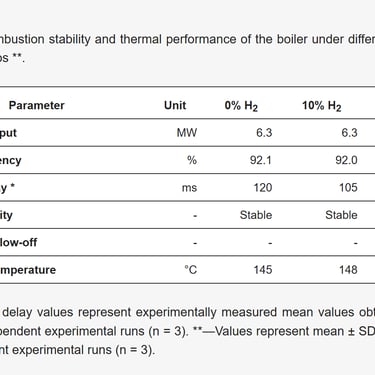
The headline is stability. Across all three blends the study reports boiler efficiency holding at roughly 92% and thermal output steady at 6.3 MW, with no flashback, no blow-off and no measurable efficiency penalty — the statistical analysis found the efficiency differences insignificant. Ignition actually got a little quicker as hydrogen went up, and the flame stayed anchored throughout.
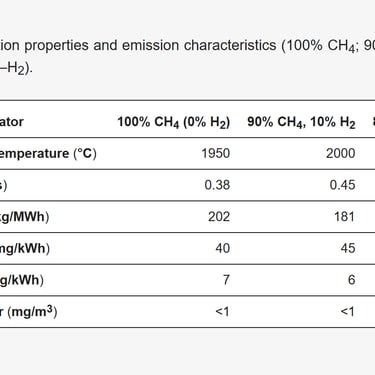
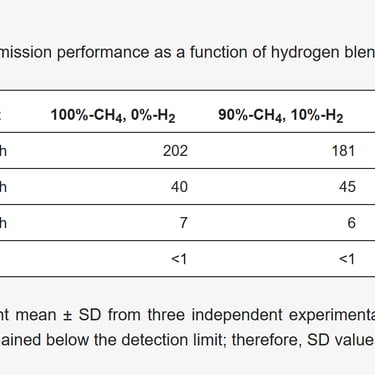
On emissions, the study reports CO₂ intensity — measured per unit of heat actually delivered — falling from 202 to 161 kg/MWh at 20% hydrogen, alongside consistently low carbon monoxide and negligible particulate matter. There is a trade-off worth naming honestly: NOx rose by around 30%, from 40 to 52 mg/kWh, driven by hotter flame temperatures. It stayed within the applicable regulatory limits here, but it is the number to watch as blends climb.
One caveat on that carbon figure, because precision matters. Hydrogen carries only about a third of methane's energy per unit of volume, so a 20%-by-volume blend is closer to 7% hydrogen by energy. The study's per-MWh normalisation is a fair way to compare like-for-like heat delivery, but the volumetric headline should not be read as a one-to-one carbon cut. We would treat the roughly one-fifth reduction as the study's reported figure rather than a settled universal.
The Baltic-first part is the part worth celebrating
Plenty of hydrogen-blending pilots have run across Europe — France's GRHYD, Romania's 20HyGrid, the UK's HyDeploy. What stands out here is that this one happened in the Baltics, on the system of Rīgas Siltums: Latvia's largest heat supplier and one of the biggest district-heating utilities in the region by network size.
That is not a small thing. Running a hydrogen experiment on a live commercial asset — one that keeps a large share of a capital city warm — takes a level of institutional nerve that is easy to underestimate. Credit is due for choosing to test rather than wait. Rīgas Siltums has been moving on several fronts: a supply already around 55% renewable and aiming for 65% by 2030, an electrode boiler for grid balancing, heat-storage plans, and stated ambitions around hydrogen and synthetic methane. This study slots into that wider picture as one more tool on the bench, not a silver bullet — and that is the right way to read it.
Why this is a power-to-X story
While still challenged by high costs and low availability, green hydrogen is an increasingly viable route to decarbonising heat — and studies like this one matter as much for the demand side as the supply side. A district-heating network that can absorb blended hydrogen is, in plain terms, an offtaker. For Baltic power-to-X developers, an early demand sink like this reduces market risk: it gives the first molecules somewhere to go while dedicated hydrogen networks and larger industrial offtake are still being built.
That is the connection we keep coming back to. The Baltics have strong wind resource, a grid now synchronised with continental Europe, and growing electrolysis ambitions — but power-to-X only scales when there is somewhere for the output to land. Existing gas-fired district heating, proven now to tolerate a 20% blend without a retrofit, is one of the more credible near-term routes for that output to find a buyer close to home.
Where it sits in the wider transition
It helps to be clear about what blending is and is not. At the EU level, the Hydrogen and Decarbonised Gas Market Package sets a modest blending reference at cross-border interconnection points, while national distribution grids keep more flexibility — so blending is treated as a transitional measure, a bridge that uses assets already in the ground rather than an endpoint. The study frames its own boiler the same way: a replicable reference for the many medium-scale gas-fired DH plants across the EU that will keep operating through the transition and need practical, low-disruption ways to cut carbon in the meantime.
The real value, then, is not that 20% hydrogen solves district heating. It is that a working Baltic boiler now sits in the evidence base, showing operators elsewhere in the region that the first step is achievable on hardware they already own.
The conclusions point in a hopeful direction
Strip the study back to its conclusions and the picture is genuinely positive for anyone backing hydrogen as part of the heat transition. The authors are measured, but the direction of travel is clear — moderate blending works on real equipment, today, and the benefits land where they matter:
20% hydrogen by volume ran in an existing 6.3 MW boiler with no hardware changes, holding stable combustion, thermal output and operational safety — for this class of plant, the technical-compatibility question is essentially answered.
Combustion stayed stable across every blend tested; hydrogen's faster, hotter flame was absorbed within the boiler's normal operating envelope, with no hit to thermal performance.
The core payoff is a measurable drop in the carbon intensity of the heat produced — a practical, near-term way to decarbonise gas-fired district heating without waiting for wholesale replacement.
NOx rises with hydrogen, but stayed within regulatory limits and proved manageable through ordinary combustion control — a trade-off to engineer around, not a blocker.
CO stayed low and particulate matter negligible, so combustion quality and local air quality held up throughout.
Taken together, the findings back hydrogen–methane co-combustion as a credible transitional strategy: cut carbon on assets already in the ground while the wider hydrogen supply chain and dedicated technologies mature.
The authors even map the outcome onto the wider goals it serves — affordable clean energy, resilient infrastructure, sustainable cities, climate action. That is the honest optimism worth carrying forward: hydrogen is not a switch you flip overnight, but this is a working, replicable first step — and the Baltics now have one on the board. Heat is so often the hardest part of the transition to move, which is exactly why a proven step like this counts.
The honest caveats
The researchers are candid about the limits, and so should we be. This was short-term operation — the tests do not capture long-term material effects like hydrogen embrittlement or seal ageing, which only show up over prolonged, cyclic exposure. It also measured emissions at the point of combustion only; there is no full life-cycle assessment of where the hydrogen comes from. That last point loops straight back to power-to-X: the carbon benefit of any blend is only as clean as the hydrogen feeding it, which is precisely why a green, Baltic-produced supply matters.
What this signals for the Baltic hydrogen ecosystem
For Baltic hydrogen ecosystem stakeholders, the takeaway is less about the specific percentages and more about direction. A live commercial boiler, run by the region's largest heat supplier, has shown that moderate hydrogen blending can be done on existing infrastructure without breaking efficiency, safety or compliance. Read the carbon numbers carefully, keep an eye on NOx and material durability, and remember that the supply-side question is still the decisive one. But as a proof point — Baltic-made, on a real asset, done rather than modelled — it is a solid, real-world marker for what the region's district-heating systems can become, and for the power-to-X demand that could feed them.
Source: Hydrogen for Heat: A District Heating Case Study from Latvia