InnoHyppy Wraps Up: A Baltic-Built Catalyst for Turquoise Hydrogen
The InnoHyppy project has reached the end of its three-year run, leaving behind a homegrown Fe-Ni catalyst for producing hydrogen from methane without the carbon dioxide of conventional reforming. We look at what a Lithuania–Latvia–Slovenia team actually delivered, and why it counts as proof of the Baltic region's R&D depth in hydrogen technologies.
NEWS
PtXBaltic
6/19/20263 min read
A three-year catalyst project closes its books
InnoHyppy has quietly reached its finish line. The project — full name Innovative catalyst and its regeneration for clean Hydrogen Production via methane Pyrolysis — ran from June 2023 to May 2026 under the M-ERA.NET Call 2022, and it has now wound down to final reporting. No fanfare, no grand launch event. Just a research consortium that set itself a hard problem, worked it for three years, and published results along the way. For a region still building its hydrogen credentials, that kind of follow-through is worth paying attention to.
Turquoise hydrogen and the case for a carbon-light molecule
Most conversations in our network centre on green hydrogen from electrolysis. InnoHyppy went down a different road: methane pyrolysis, the route that splits natural gas into hydrogen and solid carbon rather than hydrogen and CO₂. It's the chemistry behind what the industry calls turquoise hydrogen — a label the project's own team used. The appeal is direct. You avoid the process carbon dioxide that steam reforming releases, you get a solid carbon co-product instead of a gas to capture and bury, and you can lean on gas infrastructure that already exists. The catch has always been catalysts: they foul, they degrade, and replacing them constantly kills the economics.
Fe-Ni catalysts and the science of making them last
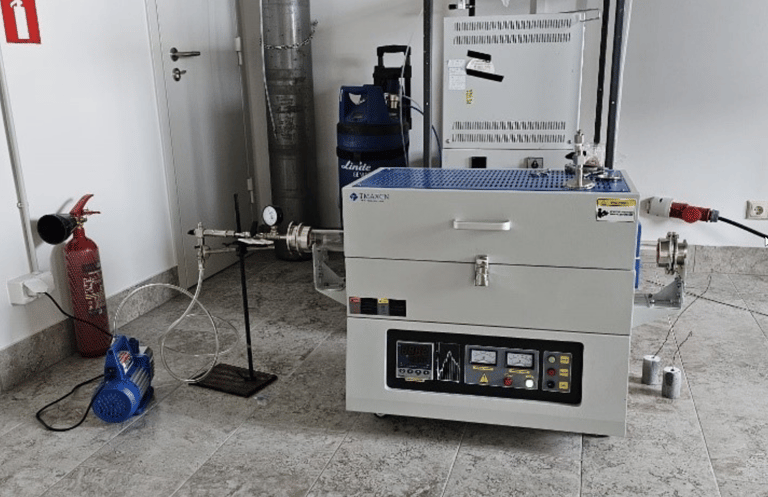
That durability problem is precisely what InnoHyppy went after. The team worked on iron- and nickel-based catalysts, built using magnetron sputtering and plasma surface treatment — techniques the Lithuanian Energy Institute has spent years refining — and focused hard on regeneration, so a catalyst could be brought back to life rather than thrown away. The leftover carbon wasn't framed as waste either, but as a secondary raw material, with one avenue pointing toward carbon-based sensors. It's a tidy piece of circular thinking: the by-product becomes a product.
A Latvia–Lithuania research axis that delivered
Here's the part that lands for Baltic hydrogen ecosystem stakeholders. Two of the three partners were Baltic. The Lithuanian Energy Institute's Center for Hydrogen Energy Technologies in Kaunas coordinated the work, alongside the Institute of Solid State Physics at the University of Latvia in Riga — one of the strongest materials science centres in the region — with Slovenia's Jožef Stefan Institute completing the consortium. And this wasn't parallel work stapled together at the end. A 2025 paper in Green Chemistry Letters and Reviews on Fe-Ni nanostructured catalysts for CO₂-free hydrogen production carries authors from both the Lithuanian and Latvian teams. That joint output is the concrete marker of what cross-border Baltic research can produce when it's properly resourced — here, on a modest total budget of €543,888.
From lab bench to whatever comes next
We'd rather be plain about the stage this sits at. InnoHyppy operated at TRL 2-4 — fundamental and early applied research, not a market-ready system. Nobody is plumbing this into a pipeline next year. But that's the honest value of it: the know-how now lives in the region, the methods are documented, and the intellectual property sits with institutions that can build on it. The hope worth stating out loud is that this base doesn't gather dust — that it feeds the next proposal, the next consortium, the next idea carried forward by people who were in the room for this one.
What this adds to the Baltic hydrogen build-out
Turquoise hydrogen won't replace electrolytic green hydrogen in our region's plans, and it shouldn't. But a low-carbon route that turns methane — including, in time, biomethane — into hydrogen plus a usable solid carbon stream is exactly the kind of optionality a maturing market benefits from. InnoHyppy reached completion on schedule and left published science behind it. That is the quiet, unglamorous shape of a research ecosystem that's actually working.
Source: LinkedIn post