
Klaipėda Opens the Baltic Ports' First Green Hydrogen Production and Refuelling Station — and Sets the Template for Riga, Ventspils and Tallinn
Klaipėda Port has officially opened Lithuania's first green hydrogen production and refuelling facility — the first installation of its kind in any Baltic seaport. We look at what the project delivers, why ports are the natural home for green energy hubs, and what Latvia and Estonia should take from Klaipėda's playbook.
NEWS
PtXBaltic
6/11/20264 min read
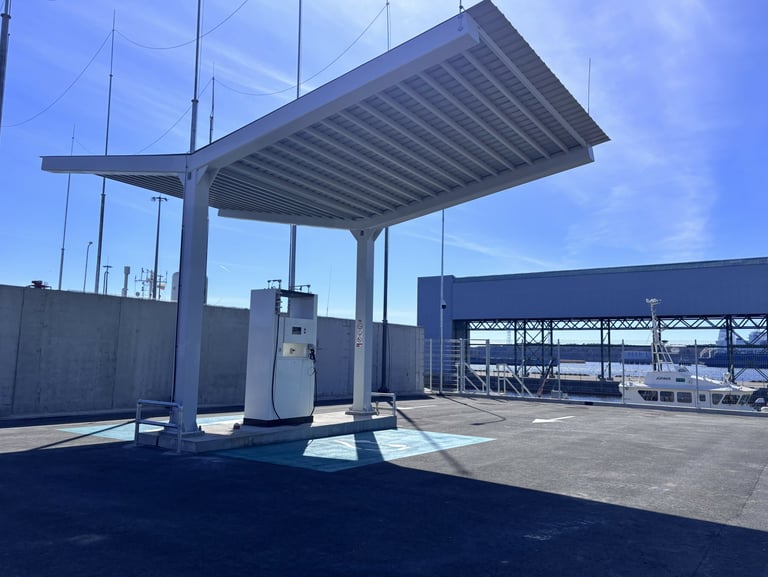
The Baltic hydrogen map gained a new landmark this June. Klaipėda Port officially opened Lithuania's first green hydrogen production and refuelling facility — and with it, the first operational installation of its kind in any Baltic seaport. After years of corridor studies, feasibility reports and funding announcements across our region, this is something different: steel in the ground, hydrogen in the dispenser, and a port authority refuelling its own operations with a locally produced clean fuel.
From ambition to operating asset in under three years
Klaipėda Port Authority launched the project in 2023. Construction began in summer 2025, key equipment arrived in October, and the first green hydrogen was produced on site in April 2026 — a development timeline that compares favourably with most hydrogen mobility projects in Europe.
We've been following closely this journey: Port of Klaipeda (Lithuania) 2.25 MW H2 project
The facility pairs on-site green hydrogen production with public refuelling infrastructure. A PEM electrolyser gives the station an annual production capacity of roughly 127 tonnes of green hydrogen, supplied to passenger vehicles, heavy-duty transport, ships and port machinery. Around a quarter of the output will be used by the port authority itself, including for a new hydrogen-powered waste collection vessel — a detail worth pausing on, because it means the port is not just hosting the infrastructure, it is the anchor offtaker.
The investment totals approximately €12 million, with around €6 million financed through the EU's NextGenerationEU recovery facility under the Next Generation Lithuania plan. The station is designed as open infrastructure, with commercial hydrogen supply expected to begin in autumn 2026. Klaipėda Port Authority is already working with LTG Group, stevedoring company BEGA and Volvo Lietuva to explore hydrogen applications in road freight, rail operations and port activities.
The facility at a glance
For readers who want the operational specifics, here is what the Klaipėda installation actually consists of, based on the Port Authority's published technical parameters:
Production technology: PEM (polymer electrolyte membrane) electrolyser, housed in a standard 40-foot marine container at the Port Authority's fleet base, Nemuno St. 40, Klaipėda
Production capacity: approximately 127 tonnes of green hydrogen per year at full operation, or around 500 kilograms per day
System power: 2.25 MW total installed power, with a planned electricity demand of around 3 MW for the production facility
Refuelling infrastructure: two stations — one for land transport, one for water transport
Dispensing pressure: 350 bar for heavy-duty vehicles and water transport, 700 bar for passenger cars
Refuelling time: roughly 20 minutes for a bus, roughly 5 minutes for a passenger car
Water consumption: approximately 22–23 litres per kilogram of hydrogen produced — around 4,200 m³ per year at full capacity, covering production, demineralisation and cooling
Access model: open public infrastructure, available to businesses and residents for ships, cars, trucks and buses
Footprint: the entire production facility occupies just 0.06–0.08 hectares — a useful reference point for any port authority assessing whether it has room for a comparable pilot
That last point deserves emphasis. The compact, containerised format means this is not a megaproject requiring years of land allocation debates. It is a deployable unit that fits inside an existing port estate — which is precisely what makes it replicable in Riga, Ventspils, Liepāja or Tallinn
Why this matters beyond Lithuania
For Baltic hydrogen ecosystem stakeholders, the significance is not the 127 tonnes. It is the demonstration logic. Klaipėda has shown, end to end, that a Baltic port can produce its own green hydrogen, build the refuelling layer on top, secure EU recovery funding to de-risk the capex, and line up local industrial partners as future offtakers — all within a single project envelope.
This is precisely the model the region's decarbonisation agenda needs. FuelEU Maritime obligations are tightening through 2030 and beyond, heavy-duty road transport is searching for practical alternatives, and ports sit exactly where renewable electricity, grid connections, industrial demand and maritime fuel demand converge. Few locations in the Baltic economy combine all four. That convergence is what makes ports the natural first home for green energy hubs — and it is why the first mover in our region was always likely to be a port, not a highway corridor station.
The lesson for Latvia and Estonia
Klaipėda's neighbours should read this opening as a working blueprint. Latvia's port system — Riga, Ventspils, Liepāja — already hosts the building blocks: the Freeport of Ventspils has signalled PtX ambitions, CIS Liepāja is structuring large-scale green hydrogen production, and NorSAF is advancing e-fuels plans in the Liepāja SEZ. Estonia, with ELWIND offshore wind on the horizon and Tallinn's maritime traffic, has an equally strong case. What has been missing is a small, fundable, operational pilot that converts strategy documents into a visible asset and gives local fleets a reason to order their first hydrogen vehicles and vessels.
Klaipėda has now de-risked that first step for the whole region. The permitting pathway, the equipment integration, the EU funding route, the port-as-anchor-offtaker structure — none of it needs to be invented twice. The honest takeaway for Latvian and Estonian port authorities and their ministries: the question is no longer whether a port-based hydrogen pilot can work in the Baltics. Klaipėda has answered it. The question is which port moves next.
We congratulate Klaipėda Port Authority and everyone involved in delivering the project. One station does not decarbonise a transport sector — but the first one changes what the region believes is possible.
Source: Klaipėda Port opens Lithuania’s first green hydrogen station