Klaipėda Port Moves Closer to Operational Green Hydrogen: Equipment Testing Begins
Klaipėda Port’s green hydrogen project is moving into equipment pressure testing, a key milestone before commissioning and first operations. With a PEM electrolyser and expected production of ~127 tonnes per year, the site is a practical step toward building real hydrogen demand and refuelling routines in the Baltic region.
NEWS
PtXBaltic
1/31/20262 min read
Klaipėda is quietly building one of the most practical pieces of the hydrogen transition: a real production-and-refuelling site that can serve day-to-day operations, not just pilots and presentations.
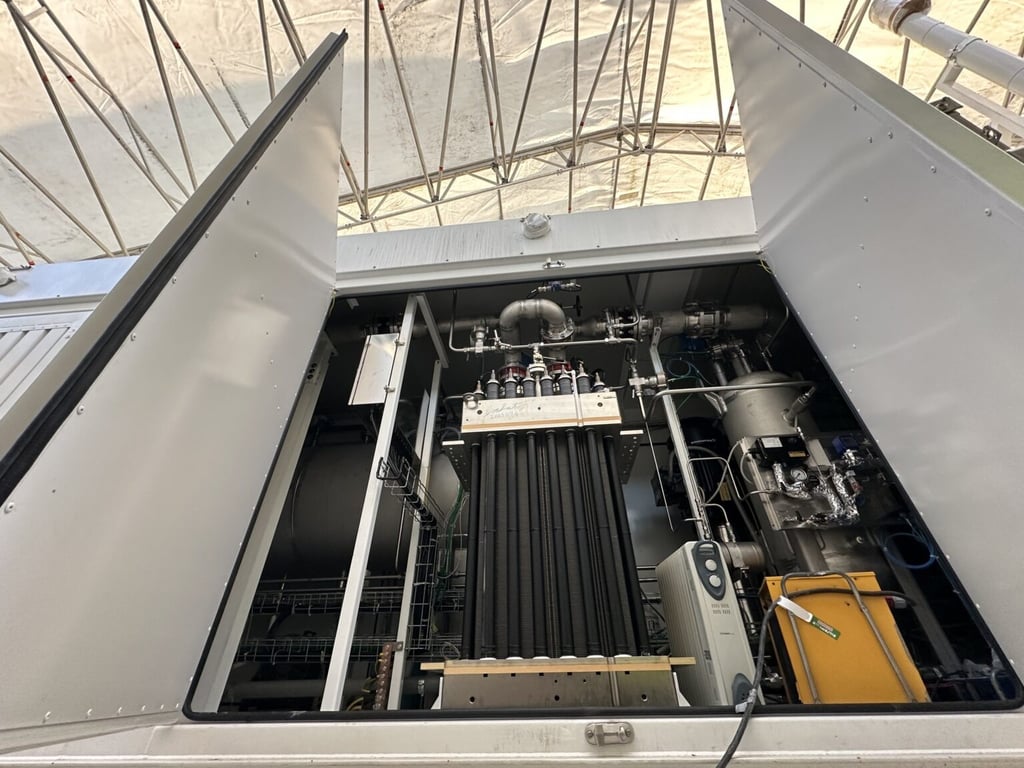
According to local reporting, the green hydrogen project being implemented in Klaipėda Port is entering a decisive phase. The core equipment has already been installed on site and connected via piping, and the project team is now preparing for pressure testing—an essential step before commissioning. If the timeline holds, the project is expected to move from construction into the start-up/commissioning phase in spring, following earlier tests already completed on the underground pipeline.
What’s being built—and why it matters
The station is planned to start operating on Nemuno Street by mid-year and will produce “green” hydrogen using a PEM (polymer electrolyte membrane) electrolyser. PEM technology is particularly relevant for ports and transport corridors because it can respond flexibly to variable renewable electricity and changing demand profiles—an important feature when hydrogen is intended for refuelling use cases.
At full capacity, the facility is expected to produce around 127 tonnes of hydrogen per year. On its own, that number won’t transform the entire regional energy system—but it’s large enough to do something more valuable: prove operational routines, safety processes, maintenance cycles, and supply logistics in a real environment.
From “infrastructure” to “ecosystem”
Hydrogen projects often stall not because the technology is missing, but because the ecosystem isn’t ready: offtakers, permitting, grid connection, safety standards, and reliable operations all need to mature together.
That’s why this stage—testing, commissioning, and first operations—is the point where a project starts generating learnings that can be replicated. For the Baltic region, every operational refuelling point reduces uncertainty for fleet operators, ports, and industrial users considering hydrogen as part of their decarbonisation pathway.
Funding signals long-term intent
The project is reported to be partially financed through EU funds (2021–2027) and Lithuania’s recovery plan measures (“New Generation Lithuania”). The total value of the hydrogen production and refuelling station project is expected to reach ~€12 million, with ~€6 million financed by EU funds.
Beyond the numbers, this is a signal: public funding is being used to de-risk early infrastructure so that private demand and investment can follow.
What we’ll be watching next
As the project transitions into commissioning, the key questions become practical:
What refuelling protocols and throughput will be achieved in real operations?
Who will be the first consistent users (port equipment, heavy-duty vehicles, municipal fleets, logistics)?
How will hydrogen supply integrate with renewable electricity availability and grid constraints?
Can this become a template for similar sites across the Nordic-Baltic corridor?
At PtXBaltic, we’ll keep tracking these “on-the-ground” developments—because the hydrogen transition will be built as much by commissioning checklists and operational reliability as by strategy documents.
Source: local reporting via Atvira Klaipėda (https://www.atviraklaipeda.lt/2026/01/23/ruosiamasi-zaliojo-vandenilio-stoteles-irangos-bandymams/)