A Steel and E-Methanol Plant on Kundziņsala Could Reshape Latvia's PtX Map
iga's Freeport has greenlit the environmental impact assessment for a combined steel and e-methanol plant in Kundziņsala — a project that could mark Latvia's first industrial-scale e-methanol facility built on captured CO2. The plant signals new momentum for Power-to-X in the Baltics and a textbook case of industrial symbiosis taking shape inside a port-based cluster.
NEWS
PtXBaltic
5/3/20264 min read
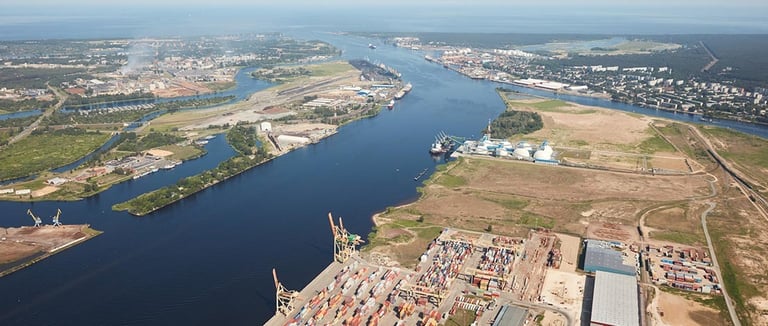
The Latvian State Environmental Bureau has confirmed that a combined steel and e-methanol plant on Kundziņsala in Riga (Latvia) will undergo a full environmental impact assessment. Behind the formality sits something much more interesting for anyone tracking Power-to-X in the Baltics: the Freeport of Riga Authority itself is the project initiator, and the planned facility ties green steel production directly to e-methanol synthesis through captured CO₂. The decision was published on 22 April 2026.
What the Project Actually Looks Like on Paper
The plant is designed around an Electric Arc Furnace running on scrap metal, with capacity of up to 250,000 tonnes of steel per year. The EAF itself is rated at roughly 45 MW. Sitting alongside the steelmaking line is an integrated methanol unit producing up to 60,000 tonnes per year, fed by CO₂ captured directly from the steel process. Annual scrap intake reaches 265,000 tonnes, water consumption is projected at around 600,000 m³, and slag — up to 35,000 tonnes annually — is earmarked for use in construction. Hydrogen sourcing and the energy supply model are still open questions to be settled inside the EIA process.
For readers familiar with European e-fuel projects, the sizing tells its own story: 60,000 tonnes of e-methanol per year would place this among the more substantial CO₂-to-methanol facilities in the wider Baltic Sea Region, comparable in scale to the early commercial plants now being commissioned in Northern Europe.
Why This Reads as a New E-Methanol Plant Signal
Latvia has talked about e-methanol for years, mostly in feasibility-study language. A formal EIA submission moves the conversation a meaningful step further. For Baltic hydrogen ecosystem stakeholders, the project ticks three useful boxes at once. It anchors a credible CO₂ source — a perennial bottleneck for carbon-based e-fuels in countries without large biogas or industrial point-source supply. It introduces concrete hydrogen demand on Latvian soil, which strengthens the business case for electrolyser deployment regionally. And it positions Riga inside the same conversation as Helsinki, Gothenburg, and the German North Sea ports, which are all racing to set up methanol bunkering capacity for the shipping sector.
The maritime angle matters. The shipping industry's pivot toward methanol-fuelled vessels is no longer hypothetical, and the Baltic Sea Region is widely projected to be a net importer of hydrogen derivatives well into the 2030s. Local supply changes that calculus.
A Textbook Case of Industrial Symbiosis Inside a Port Cluster
What makes the Kundziņsala project particularly interesting is the cluster forming around it. The Freeport of Riga has spent the past two years systematically rebuilding Kundziņsala into a green-industrial hub. Amber Flow Fuels is preparing to start construction of the first Baltic HVO and SAF production plant on the same island, a €120 million investment due online in 2027.
Read project section: The Amber Flow Fuels 87 kta SAF plant in Freeport of Riga (Latvia)
Wind-technology manufacturing facilities are planned on 76 hectares of leased land for offshore and onshore component production. Across the Daugava in Spilve Meadows, one of the largest solar parks in the Baltics is taking shape on 177 hectares, with hydrogen and alternative fuel production explicitly written into the development plan.
The steel and e-methanol plant slots into this picture with almost suspicious neatness. Captured carbon from steelmaking becomes feedstock for methanol. Renewable electricity from the Spilve solar park can flow into both electrolysis and the EAF. Wind components manufactured next door feed the same renewable build-out that ultimately supplies the green hydrogen. Port logistics handle scrap inbound and methanol outbound. This is industrial symbiosis as it appears in the textbooks — not a slogan, but co-located processes turning each other's outputs into inputs.
Credit Where It Is Due — the Freeport of Riga's Strategic Patience
It is worth saying plainly: not every port authority would have the appetite or the patience to host this kind of development. The Freeport of Riga has quietly built up an industrial-strategy stack — its participation in BalticSeaH2, the Spilve technology centre concept, the Kundziņsala overpass and digitised port control point, the wind-tech complex — that reads as a coherent ten-year bet on the energy transition rather than a series of opportunistic deals. Hosting a steelmaking and e-methanol facility inside a port cluster, with all the permitting, infrastructure and stakeholder work that implies, takes that bet a step further.
Cluster-based industrial development is one of the few proven recipes for making PtX projects bankable. Shared infrastructure spreads capex. Co-located offtake reduces commercial risk. Permitting becomes incremental rather than greenfield. The Port of Riga has been doing the unglamorous groundwork; the Kundziņsala project is the kind of result that work was meant to produce.
What to Watch Next
Several things will determine whether this project becomes a genuine PtX milestone for the region or another study on the shelf. The hydrogen sourcing model is the obvious one — captive electrolysis, a corporate PPA with the Spilve solar park, a connection to the Nordic-Baltic Hydrogen Corridor once it materialises, or some combination thereof. The EIA timeline and any public consultation outcomes will shape construction scheduling. And the offtake side, particularly which shipping lines or chemical buyers commit to long-term methanol contracts, will tell us how serious the commercial backing actually is.
For now, the signal is the news. Latvia has a real e-methanol project in the formal permitting pipeline, sitting inside one of the most strategically developed port-industrial clusters in the Baltic Sea Region. That alone justifies attention.
Source: Tērauda un e-metanola ražošanas rūpnīcas būvniecība Kundziņsalā, Rīgā (Rīgas brīvostas pārvalde)