Latvia's Hydrogen Backbone Takes Shape: EIA Launched for the Nordic–Baltic Hydrogen Corridor
Latvia's State Environmental Service has greenlit a full Environmental Impact Assessment for the Nordic–Baltic Hydrogen Corridor, marking the first concrete regulatory step toward a 270 km hydrogen pipeline across Latvia. Here is what the Conexus Baltic Grid filing reveals about route, capacity, and timeline for the Baltic hydrogen market.
NEWS
PtXBaltic
4/29/20264 min read
A regulatory milestone with real-world consequences
On 17 April 2026, Latvia's State Environmental Service (Valsts vides dienests, VVD) issued Decision No. 11.17/AP/3695/2026 requiring AS "Conexus Baltic Grid" to conduct a full Environmental Impact Assessment for the Latvian section of the Nordic–Baltic Hydrogen Corridor (NBHC). For anyone tracking the Baltic hydrogen story, this is the moment the project crossed from strategic ambition into formal permitting. It is also the first time the Latvian segment of this 2,500-kilometre, six-country corridor has been described in regulatory detail at the national level.
The NBHC is no abstract concept. Conexus Baltic Grid, together with Gasgrid Finland, Elering, Amber Grid, GAZ-SYSTEM and ONTRAS, has been advancing the corridor as a Project of Common Interest since November 2023, with €6.8 million in CEF funding secured for the feasibility phase in July 2025. The EIA decision is the regulatory counterpart to that engineering and economic work — and it is where the Latvian route becomes tangible for landowners, municipalities, and the wider Baltic hydrogen stakeholders watching the value chain take shape.
What the Latvian filing actually says
Conexus submitted its formal application on 2 April 2026, and VVD's decision confirms that the activity falls squarely under Annex 1, point 22.1 of Latvia's Law on Environmental Impact Assessment — pipelines exceeding 800 mm in diameter and 40 km in length transporting gas. EIA is therefore mandatory, not discretionary. The decision also classifies the project as having transboundary environmental effects under the 1991 Espoo Convention, which means Estonia and Lithuania are formally recognised as potentially affected states and will be brought into the consultation process under the 1997 Latvia–Estonia bilateral agreement on transboundary EIA.
A few specifics stand out from the application:
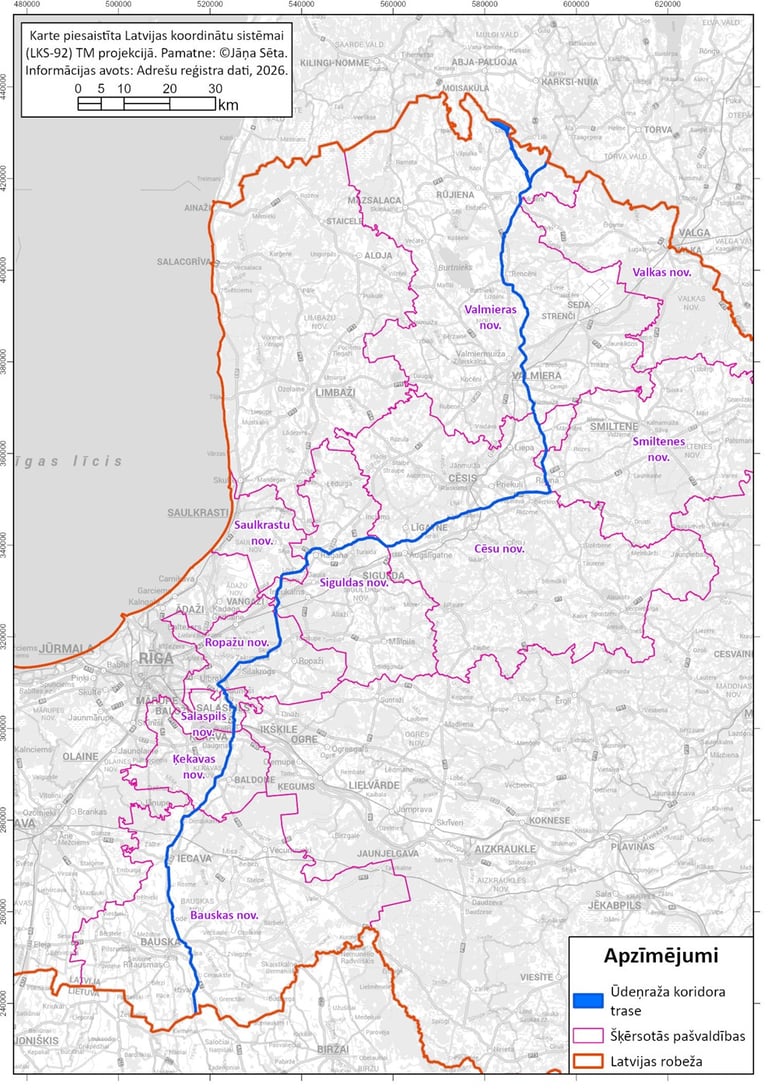
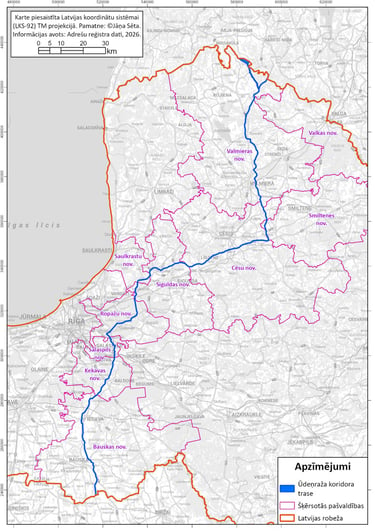
The Latvian section is planned at roughly 270–300 km in length, crossing ten municipalities — Valmiera, Smiltene, Valka, Cēsis, Sigulda, Saulkrasti, Ropaži, Salaspils, Ķekava and Bauska. The route mostly follows the existing natural gas transmission pipeline, with a minimum separation of about 15 metres between pipeline axes, which is a deliberate choice to leverage existing rights of way, geotechnical knowledge, and operational corridors. Construction will rely primarily on open-trench techniques, with trenchless methods reserved for sensitive crossings.
The investigation corridor is set at 50 metres on either side of the existing gas pipeline axis for the main route and Alternative 1, expanding to 200 metres for Alternative 2. That second alternative explores a new corridor running from Mirķi (Valmiera municipality) toward the Estonian border near Lodes, signalling that Conexus is keeping flexibility on where exactly the cross-border interconnection with Estonia lands. The southern interconnection point with Lithuania has been preliminarily agreed south of Uzvaras village in Bauska municipality.
Capacity numbers that reframe the Baltic energy map
The capacity figures in the filing deserve attention. Conexus indicates that annual energy throughput across the full Nordic–Baltic Hydrogen Corridor could reach approximately 90 TWh by 2040 and exceed 120 TWh by 2050. To put that in perspective, that is comparable in energy terms to a substantial share of regional natural gas flows today, but carrying renewable molecules instead. Latvia's own pre-feasibility assessment, conducted alongside partners through AFRY in 2024, identified roughly 27.1 million tonnes of regional renewable hydrogen production potential by 2040, with the corridor projected to move up to 2.7 million tonnes annually between member states.
Translating those figures into business terms: the Latvian segment positions the country as a transit node between Finnish and Estonian renewable production zones and Central European demand centres in Germany and Poland. That is a structurally different role from being a pure consumer market, and it is one of the more meaningful strategic shifts in Latvia's energy posture in a generation.
Sensitive ground and the Espoo dimension
The EIA will need to grapple with genuine environmental complexity. The investigation corridor crosses the Ziemeļvidzeme Biosphere Reserve, the Augstie kalnu meži and Tumšupes meži nature reserves, and several Natura 2000 sites — Gauja National Park, the Ziemeļgauja protected landscape area, and the Rāceņmuiža alley. The pipeline will also cross the Gauja and Daugava rivers, the planned Rail Baltica corridor, and a number of cultural heritage protection zones.
Conexus has flagged that crossing solutions will be defined during the EIA and refined again at the construction design stage. The transboundary dimension under the Espoo Convention adds another layer: Estonian and Lithuanian publics will have the right to participate in the Latvian EIA process on equivalent terms to Latvian residents, with Latvia–Estonia coordination focused on a 15 km zone from the shared border. That cross-border consultation requirement is exactly the kind of process discipline that distinguishes well-prepared infrastructure projects from those that stall in court.
What happens next
VVD has confirmed that the initial public consultation must be held in hybrid format, with at least one in-person meeting open to remote participants — reflecting the geographical scale of the project and the number of affected parties. After the initial consultation, Conexus can request VVD to issue the EIA programme, which will set the scope and depth of the studies required for the assessment proper.
For Baltic hydrogen stakeholders, the EIA process opens a structured window to influence routing assumptions, crossing methods, and connection-point logic before they harden into engineering decisions. Hydrogen producers planning electrolyser projects along the corridor, port operators eyeing offtake or import roles, and industrial offtakers in chemicals, steel and mobility now have a clear regulatory anchor against which to align their own siting, permitting, and grid-connection planning.
The bigger picture for the Baltic hydrogen market
The NBHC is not the only large-scale hydrogen infrastructure play in the region — the offshore Baltic Sea Hydrogen Collector is advancing in parallel, as are national hydrogen valley initiatives across all three Baltic states and Finland. What distinguishes the Conexus filing is that it converts Latvia's place in that wider map from a planning-document line into a permitting reality. Combined with the project partners' ongoing Call for Interest survey, which closed at the end of March 2026 and will inform routing and corridor design, the EIA launch gives the market a credible answer to the question of when, where, and at what scale Baltic hydrogen transmission will be built.
The Latvian decision is one regulatory step among many still to come. But it is the step that signals the Baltic hydrogen corridor is moving from feasibility into delivery — and the next two to three years of EIA work, public consultation, and design refinement will determine how cleanly that transition lands.