Liepāja’s NorSAF public hearing showed what serious PtX projects now require: scrutiny, transparency and local trust
Liepāja’s public hearing on the planned NorSAF SAF and eSAF plant showed that major PtX projects in the Baltics are entering a more demanding phase, where strategic ambition must be matched by technical clarity, environmental assessment and public trust. For Latvia’s hydrogen and synthetic fuels landscape, the meeting was an important reminder that real project momentum is built not only through investment announcements, but through credible engagement with local stakeholders.
NEWS
PtXBaltic
3/25/20264 min read
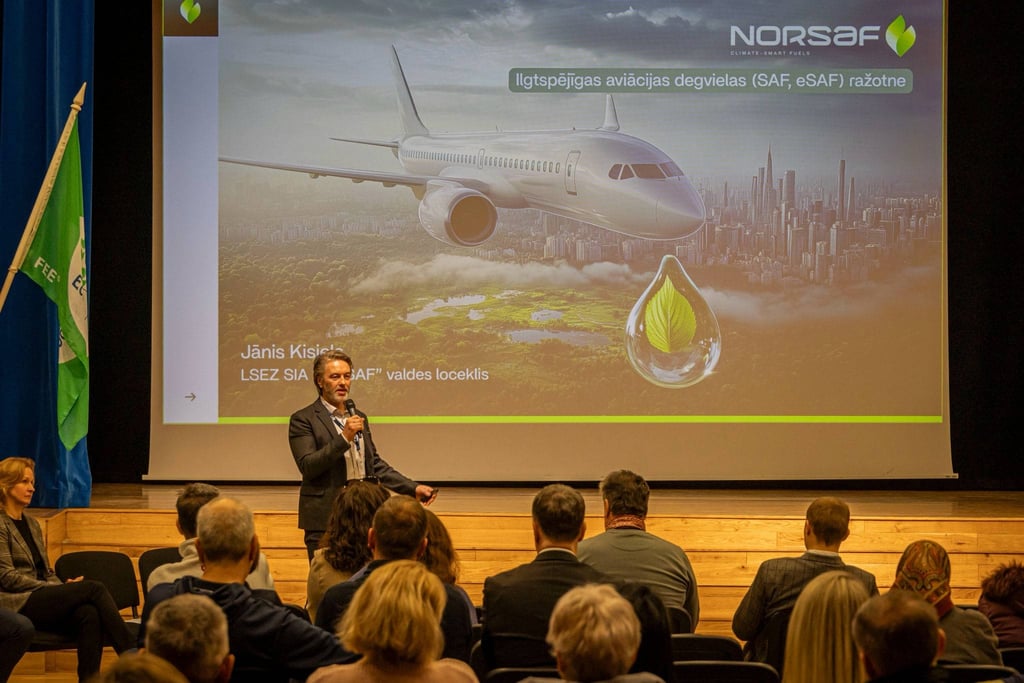
The public hearing on the planned NorSAF sustainable aviation fuel project in Liepāja was not a formality. It was a long, highly attended, detail-oriented session that showed both the scale of local interest and the level of scrutiny that new e-fuels projects in the Baltics should expect. According to local reporting, more than 200 residents joined the initial public consultation in person and online, while Liepāja SEZ reported 162 participants on site and 51 attending remotely. The key takeaway was clear: in Liepāja, no foundation stone will be laid before the project has gone through a much tougher test first — public confidence.
A public hearing that went far beyond procedural box-ticking
The meeting took place on 4 March 2026 as part of the initial Environmental Impact Assessment process for the proposed NorSAF plant in Liepāja’s Northern suburb, with both physical and online participation enabled. The hearing was designed to introduce the project and explain the EIA process, but it quickly became something more substantial: a prolonged exchange in which residents directed many questions to both the developer and Liepāja SEZ management. Local media noted that the questioning continued for more than an hour and extended beyond the immediate project scope, which is often a sign that the debate has moved from a technical project review into a broader discussion about industrial direction, risk tolerance and local development priorities.
What was actually discussed in the room
From a PtX and industrial development perspective, the hearing was important not only because of the attendance, but because of the type of issues being raised. The official EIA process now has to examine the proposed technologies, environmental impacts and safety aspects in detail before any later-stage public consultation on the completed EIA report, which Liepāja SEZ says is expected in the second half of 2026. That means the public hearing functioned as an early filtering stage: residents were not reacting to a symbolic announcement, but pressing for clarity on how the project would work, what it would mean for people and place, and how risks would be assessed before any project advancement.
Why this project matters for the Baltic PtX landscape
NorSAF is positioned as more than a conventional biofuel plant. The project is framed around SAF and eSAF production in Liepāja SEZ, linked to hydrogen and CO2 handling infrastructure, which places it firmly inside the broader Power-to-X conversation rather than only within traditional fuels upgrading. Earlier reporting on the project stated an expected production capacity of up to 100 kilotonnes per year, while more recent project-linked coverage indicates a 100,000-tonne annual output target, including around 40,000 tonnes of eSAF, with production planned from 2030. That scale is material in Baltic terms and explains why the hearing drew such attention: this is not a niche demonstration plant, but a project presented as one of the larger future green fuels platforms in Northern Europe.
The strategic context: ReFuelEU is turning SAF supply into an industrial question
The timing also matters. Under ReFuelEU Aviation, fuel suppliers at EU airports already face a 2% SAF obligation from 2025, rising to 6% in 2030, with a specific synthetic aviation fuels requirement beginning in 2030. That turns projects such as NorSAF from speculative ideas into part of the emerging industrial response to regulation. For the Baltics, this is strategically relevant: the region will either participate in SAF and eSAF supply chains or remain primarily a demand-side market dependent on imported compliance fuels. In that sense, the Liepāja hearing was not only about one plant. It was also about whether the Baltic region is prepared to host the infrastructure that future aviation decarbonisation will require.
What NorSAF and Liepāja SEZ are putting on the table
Liepāja SEZ presents the project as a strategically important industrial investment tied to climate goals, energy security and regional competitiveness. In its public materials, the project is described as aligned with Latvia’s RIS3 priorities, already granted Green Corridor status, and expected to support around 200 high value-added operating jobs plus roughly 200 more during construction. Project-linked reporting has also referenced an estimated investment size of around EUR 650 million. For PtXBaltic readers, that combination is significant: regulatory pull, port-industrial location, hydrogen linkage, and export-oriented green fuels production is exactly the type of project profile now shaping the next wave of Baltic clean industry.
What the public hearing really showed
The most important signal from the hearing was not support or opposition in a simplistic sense. It was the fact that public acceptance for large-scale PtX projects will depend on a credible process, not only on strategic narratives. Residents came prepared, stayed engaged and used the hearing to test the robustness of the proposal. That is healthy. For developers, ports and policymakers, this is the real lesson from Liepāja: the era of announcing advanced energy projects through headline values alone is over. Projects now need to demonstrate technical realism, environmental discipline, safety preparedness and social legitimacy from the earliest stages onward.
What comes next
The formal process is still at an early stage. Written proposals from residents and institutions were invited until 12 March 2026, after which the State Environmental Service is to prepare the EIA programme. Experts will then assess the chosen technologies, environmental impacts and safety issues, followed by preparation of the EIA report and another round of public consultation later in 2026. In other words, Liepāja has not reached a construction milestone. It has reached the point where project ambition must now stand up to procedural, technical and societal examination. For the PtX sector, that is not a weakness. It is the threshold that serious projects must cross.
Why PtXBaltic should keep watching Liepāja
For the Baltic PtX ecosystem, Liepāja is becoming a live case study in how synthetic fuels projects move from concept into public reality. The NorSAF hearing showed that the region’s next-generation fuel projects will be judged not just by their decarbonisation claims, but by their industrial credibility, system integration and ability to answer difficult local questions in public. That is exactly how it should be. If the project advances successfully through EIA and later investment decisions, Liepāja could strengthen its position as one of the Baltic’s most closely watched green fuels locations.
Source: “Pamatakmeni vēl neliks” – liepājnieki stundām iztaujā par aviācijas degvielas rūpnīcu