Lithuania moves to put hydrogen under energy law — and the EU clock is running
Lithuania's Government has approved a dedicated Hydrogen Law that would regulate production, transmission, storage and trade the way gas and electricity already are. We look at what the package contains, why the 5 August EU transposition deadline makes the timing tight, and what it changes for developers weighing the three Baltic markets.
POLICY
PtXBaltic
7/15/20264 min read
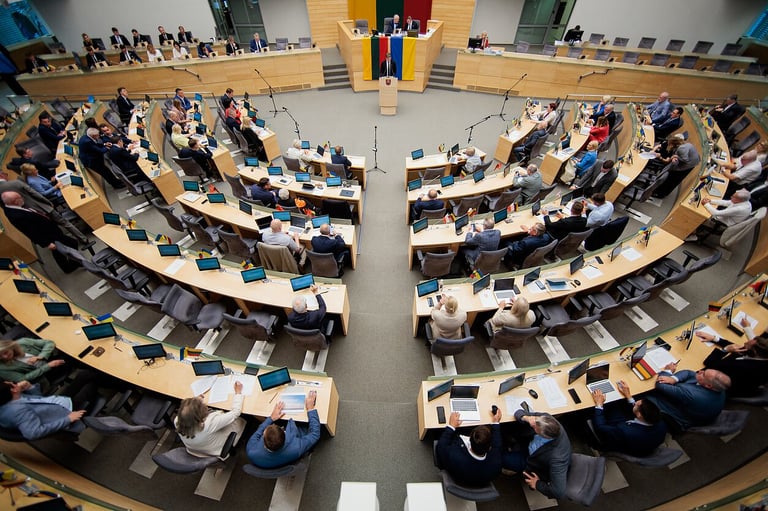
Klaipėda Port has been producing green hydrogen since April. Vilnius has a 3 MW electrolyser going in alongside the city's district heating system. Both are real. Both are steel in the ground. And until this month, Lithuanian law had almost nothing to say about either of them — hydrogen simply wasn't regulated as part of the energy sector.
On 8 July 2026, the Government moved to change that.
Projects first, rules second
The Government backed the Energy Ministry's proposal for a dedicated Hydrogen Law, together with amendments to the Energy Law and to the law on the protection of objects important to national security. The ministry's own explanatory note is blunt about the starting point: current legislation doesn't regulate the hydrogen sector as part of energy at all. Acting energy minister Žygimantas Vaičiūnas framed the goal as creating the conditions for a hydrogen market to emerge in Lithuania while ensuring the infrastructure is safe and technically compliant.
That ordering — assets before architecture — is worth sitting with. Lithuania didn't wait for a legal framework before putting electrolysers in the ground. It built first and is now writing the rules around what exists. Whether that's pragmatism or an accident of sequencing, it's the situation the sector is actually in.
What the package puts on the statute book
The scope is broad. According to the ministry's note, the draft laws set out to govern relations connected with hydrogen production, transmission, distribution, storage, supply, trade, consumption, and the development, operation and connection of the associated infrastructure — plus licensing of hydrogen activities, permitting, and the conditions for entering the market.
In plain terms: a hydrogen market structured the way the natural gas and electricity markets already are. Hydrogen also gets named as a strategically important energy resource, which is what the amendments to the national security objects law are doing in the package. That's not decoration — it determines how infrastructure gets treated when someone applies to build it.
Four weeks from the deadline, and the Seimas still has to vote
Adopting the changes would transpose the EU directive setting common rules for the hydrogen market — Directive (EU) 2024/1788, the hydrogen and decarbonised gas package. The transposition deadline is 5 August 2026.
So the Government cleared this with roughly four weeks to spare, and the draft still needs the Seimas. That's tight, and it's tight in good company: transposition of this package has been slow across the EU, with member states broadly behind schedule rather than ahead of it. Lithuania's own hydrogen development plan for 2025–2027 had already set the target of having market regulation in place by the end of this year, so the direction was signalled — the calendar just got specific.
We'd flag the political layer too. Vaičiūnas spoke as acting minister; Lithuania's twenty-first Government was confirmed on 14 July with Lukas Savickas at the energy portfolio. Government-approved drafts survive cabinet changes, but the parliamentary timetable now sits with a new team.
One deadline, one derogation, three Baltic states
The same 5 August date applies to Latvia and Estonia. What Lithuania has done that's visible and dated is put a dedicated hydrogen law through cabinet and name a licensing regime. Anyone comparing the three markets should check the current state of play in Riga and Tallinn directly rather than assume parity — legislative progress in this area moves quietly and isn't always well covered.
One provision does treat the three identically, and it matters more than it first appears. The directive grants Estonia, Latvia and Lithuania an automatic derogation from the legal horizontal unbundling of hydrogen transmission network operators, running until 2031, on the grounds of remote location and limited market size. The recitals are explicit about it. Practically, that means a Baltic gas or electricity network operator can hold hydrogen network activities inside the group for the rest of this decade, with separation of accounts under regulatory monitoring rather than full structural separation. For a market this small, that's the difference between a hydrogen network operator being viable and being a paper entity.
Why a licensing regime beats another funding round
Baltic hydrogen ecosystem stakeholders have spent several years watching money arrive faster than clarity. Klaipėda's facility cost roughly €12 million with around €6 million from EU funds via the Next Generation Lithuania recovery plan. Vilnius secured up to 70% of a roughly €10 million project through EU structural funds. Capital hasn't been the binding constraint.
What a licensing and market-entry regime does is different in kind. It tells a developer who grants the licence, on what terms, how third parties get network access, and what happens when a project wants to sell hydrogen to someone other than itself. Those are the questions that decide whether a bank will lend against an offtake contract. While still challenged by high costs and low availability, green hydrogen is an increasingly viable route to decarbonising industrial processes — but viability needs a counterparty who can sign, and signing needs rules.
The targets this framework will have to carry
The ambition attached to all this is substantial. The 2024–2050 hydrogen development guidelines, adopted under the previous conservative-led government, target at least 1,300 MW of installed electrolysis capacity by 2030, 129,000 tonnes of clean fuel per year, and at least 41% of ammonia fertiliser produced from green hydrogen. By 2050 the figures rise to 8,500 MW, 732,000 tonnes annually, with 44,000 tonnes available for export.
Set those against what exists. Klaipėda's plant runs on a 3 MW electrical input and is designed for around 127 tonnes a year, with commercial supply expected this autumn. Vilnius adds another 3 MW. Reaching 1,300 MW by 2030 from that base is a very steep curve, and nothing in the legal package changes the physics or the economics of it. What the package does is remove the excuse that the rules weren't there.
What this signals
The interesting part of the 8 July decision isn't the ambition — it's the plumbing. Licensing, permitting, market-entry conditions and network access are unglamorous, and they are exactly what a market needs before it can price anything.
For developers, OEMs and investors weighing where in the Baltics to commit, the signal is that Lithuania is putting hydrogen inside the energy legal system rather than leaving it in a policy annex. The 2030 targets remain aspirational against a base of a handful of megawatts. But a project needs a licence before it needs a target, and Lithuania is now four weeks and one parliamentary vote away from being able to issue one.
Source: Vyriausybė pritarė pirmiesiems žingsniams link vandenilio rinkos sukūrimo