Lithuania’s Hydrogen Market in 2025: Project Pipeline, Grid Strategy and Export Potential
Amber Grid’s 2025 survey showed a Lithuanian hydrogen market that remained ambitious, but became more selective, with infrastructure, industrial use cases and export logic moving closer to the center of project planning. For Baltic stakeholders, Lithuania’s opportunity now looks strongest where hydrogen production, transmission, derivatives and real offtake can be built as one integrated market story.
NEWS
PtXBaltic
4/20/20264 min read
Lithuania’s hydrogen market looked more disciplined in 2025
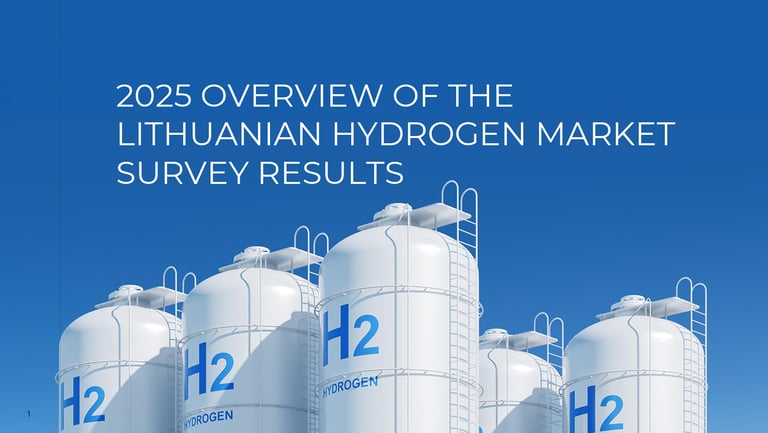
Looking back at the 2025 survey results, the most important shift was not a dramatic surge in headline project numbers, but a clearer market structure. The uploaded report shows 23 hydrogen projects in Lithuania in 2025, up only slightly from 22 in 2024, with 12 in early development, 4 in engineering, 4 at idea stage and 3 suspended. That is not a picture of speculative overheating. It is a picture of a market that kept moving, while filtering projects through stricter economic and regulatory realities.
The chart on page 3 also points to where the market was clustering. Most projects were still concentrated in the smaller size bands, with 16 of 23 electrolysis developers planning capacities of up to 100 MW, while only a limited number were moving toward larger-scale systems. At the same time, the survey found that eight market participants were considering hydrogen derivatives such as methanol, methane and ammonia, and ten producers were targeting both Lithuania and export markets. That matters because it shows the country’s hydrogen story was already moving beyond pure molecule production toward a broader PtX value chain.
Infrastructure became the real investment trigger
One of the clearest messages in the 2025 report was that hydrogen production in Lithuania is tightly linked to transmission infrastructure. The report’s conclusions state this directly: timely development of the hydrogen network, coordination with power system planning, and better alignment with future electrolysis locations were seen as core market accelerators. It also flagged two familiar brake factors for the sector: stringent RFNBO and RED-related requirements, and the financing burden of complex hydrogen and synthetic fuel projects.
That logic has only become more relevant. Amber Grid states that the Nordic-Baltic Hydrogen Corridor entered its feasibility phase in 2025, with national and cross-border studies expected to conclude in early 2027. In practice, this means Lithuania’s hydrogen opportunity is no longer just about domestic project announcements. It is increasingly tied to whether Lithuania can connect production zones, industrial demand and cross-border flows into bankable infrastructure.
Export potential moved from theory toward market logic
The strongest signal in the report is the network balance. According to the survey charts on pages 5 to 7, projected hydrogen injection into the transmission network reached 15.6 TWh by 2050, while projected offtake from the grid was about 8.54 TWh. That left a potential export balance of around 7 TWh, with the report explicitly pointing to exports to Poland and Germany by 2050. In other words, the 2025 data suggested that Lithuania was not positioning itself only as a local hydrogen user, but as a future regional supplier.
This export logic sits well with Lithuania’s broader energy strategy. The National Energy Independence Strategy says Lithuania plans to become a country that produces energy for its own needs and exports it, while also targeting 8.5 GW of hydrogen electrolysis capacity by 2050. Taken together, the survey data and the national strategy suggest that Lithuania is treating hydrogen not as a side technology, but as part of a wider energy and industrial positioning strategy in the Baltic region.
Lithuania’s opportunity is strongest where industry and logistics already exist
The report and Amber Grid’s accompanying market commentary both point to the same offtake logic: hydrogen in Lithuania is expected to be used first where regulation and industrial demand are strongest, especially in fertiliser production, oil refining, shipping and aviation. That matters for investors because these are not abstract demand categories. They are sectors with existing assets, existing energy consumption and growing decarbonisation pressure.
Klaipėda is a good example of why Lithuania deserves close attention. The Port of Klaipėda says it will launch Lithuania’s first public hydrogen refuelling station in 2026, open to businesses and residents, with hydrogen available for ships, trucks, buses and cars. The project is designed around a 2.25 MW system with annual hydrogen production of roughly 127 tonnes. This is still modest in scale, but strategically important: it moves hydrogen from strategy documents into visible port and mobility infrastructure.
The industrial side is just as relevant. ORLEN Lietuva states that access to cheap and stable renewable electricity will be critical for green hydrogen and synthetic fuel production, and that its 42.2 MW photovoltaic plant is due for completion in 2026. That does not mean Lithuania’s refinery sector has already solved the hydrogen business case. It does mean one of the country’s most important industrial anchors is explicitly linking renewable power, hydrogen and future synthetic fuels in its transition planning.
PtX derivatives may become Lithuania’s highest-value lane
For a PtXBaltic audience, one of the most important takeaways from the 2025 report is that Lithuania’s hydrogen opportunity is not limited to direct molecule sales. The report already showed interest in methanol, methane and ammonia, and Lithuania’s National Energy Independence Strategy goes further by stating that hydrogen derivatives such as ammonia could contribute to both decarbonisation and energy product exports. The same strategy sets a target of at least 2 TWh of hydrogen derivatives by 2030 and at least 9 TWh by 2050.
This is where Lithuania’s position becomes especially interesting for Baltic stakeholders. The country combines industrial demand centres, a serious transmission planning agenda, a growing offshore and onshore renewable base, and a logistics gateway through Klaipėda. Add in the corridor concept and the derivatives push, and Lithuania starts to look less like a small national hydrogen market and more like a practical Baltic platform for PtX scale-up. That is an inference from the available evidence, but it is a well-grounded one.
A stronger Baltic signal from the 2025 data
In retrospect, the 2025 survey did not show a market racing ahead blindly. It showed a market getting more realistic. Some projects stalled, regulation stayed heavy, and financing remained difficult. But the underlying direction was still clear: Lithuania was building a more credible hydrogen investment case around infrastructure, industry, export potential and higher-value derivatives, not around volume alone.
For Baltic stakeholders, that is the real message worth carrying forward. Lithuania’s opportunity is no longer just that it has hydrogen projects on paper. Its opportunity is that the country is gradually assembling the harder pieces of a bankable market: corridor logic, industrial anchors, port applications, renewable power and a clearer PtX pathway. That is exactly where the next phase of Baltic hydrogen competition is likely to be decided.
Source: 2025 OVERVIEW OF THE LITHUANIAN HYDROGEN MARKET SURVEY RESULTS