NorSAF and KBR Sign Licensing Deal That Locks In Northern Europe's Largest SAF Plant
NorSAF has signed a permanent licensing agreement with US engineering firm KBR to deploy PureSAF® technology at Northern Europe's largest planned sustainable aviation fuel plant in Liepāja, targeting 100,000 tonnes of SAF and eSAF a year from 2031. We break down what the deal means for the Baltic green hydrogen and Power-to-X value chain, the role of green-hydrogen-derived eSAF under ReFuelEU Aviation, and the milestones that will decide whether the project reaches construction.
NEWS
PtXBaltic
6/1/20264 min read
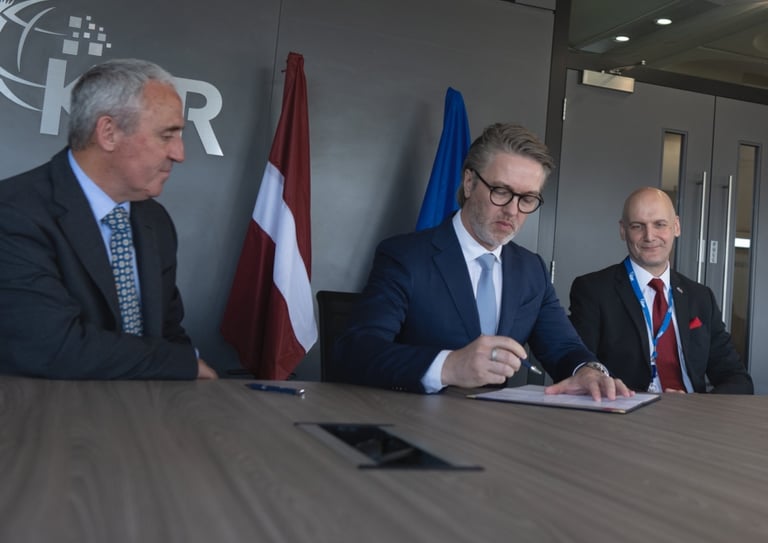
A milestone worth understanding properly. A few weeks back we covered the early signals out of Liepāja — CIS Liepaja and NorSAF agreeing to work together on hydrogen and aviation fuel. Now there's a concrete contract behind the ambition. On 29 May 2026, NorSAF, operating in the Liepāja Special Economic Zone, signed a permanent licensing agreement with the US engineering firm KBR to deploy PureSAF® technology at what's planned to be the largest sustainable aviation fuel facility in Northern Europe. This is the kind of step that turns a press-release project into a buildable one.
What the agreement actually does
The license gives NorSAF exclusive rights to use PureSAF® in Europe. The technology itself was developed by the Swedish company Swedish Biofuels AB, with KBR acting as its exclusive global commercialisation and sales partner. In plain terms: NorSAF now holds the European rights to a process that the rest of the continent can't simply copy next door.
What makes PureSAF different is worth dwelling on. Most sustainable aviation fuels can only be used blended with fossil jet fuel — typically diluted somewhere in the 10–50% range. PureSAF contains aromatic components, which is the technical reason it's compatible with every modern aircraft engine and existing fuelling infrastructure without major modification. According to the project, it can function as a 100% "drop-in" fuel — usable neat, no fossil blend required, behaving like standard Jet A-1. Test flights conducted by the Swedish armed forces and the US Air Force have already demonstrated that PureSAF can fully replace conventional jet fuel.
One thing to verify before you cite it: the article notes PureSAF is currently certified for use in a 50/50 blend with fossil fuel, while full 100% drop-in certification through ASTM (the international standards body for aviation fuel) is still in progress. Industry participants reportedly expect those approvals could come through this year. That's a forecast, not a done deal — treat it as such.
The numbers behind the Liepāja plant
The facility is planned to start operating in 2031, producing 100,000 tonnes of SAF and eSAF per year. It's designed to make two products under one roof: conventional SAF from CO₂ and second-generation bioethanol, and synthetic aviation fuel — eSAF — from green hydrogen and biogenic CO₂.
That second pathway is the part that matters most for Baltic hydrogen ecosystem stakeholders. The eSAF route runs on hydrogen produced via electrolysis using renewable electricity, then combined with captured carbon to close a full green-energy loop. The project's own estimate is roughly 83% lower greenhouse gas emissions than conventional jet fuel production. We'd flag that figure as the developer's projection — worth confirming against the eventual lifecycle assessment, since SAF emissions claims hinge heavily on feedstock and electricity assumptions.
All feedstocks are intended to be sourced within Europe. That's a deliberate framing, and the project leadership leaned into it: the messaging positions energy independence as a security priority, not just an economics one — reducing reliance on external fossil markets while strengthening European industrial resilience.
Why this sits at the centre of the PtX story
Here's what we mean. eSAF is essentially Power-to-X in its most demanding form — you take renewable power, make hydrogen, capture carbon, and synthesise a liquid fuel that an aircraft can burn today. If you want a single project that proves the Baltic PtX value chain can reach a real offtake market, this is close to the textbook case. Green hydrogen on its own struggles for bankable demand. Aviation fuel under a regulatory mandate is demand you can underwrite against.
That mandate is ReFuelEU Aviation. The regulation steps SAF use up over time — from 6% in 2030 (including a minimum 0.7% eSAF) toward 70% by 2050 (including at least 35% eSAF). Read that eSAF sub-target carefully: it's the policy engine that converts "interesting hydrogen demonstration" into "fuel someone is legally required to buy." Fuel produced in Liepāja is intended to supply European aviation companies working to cut their carbon emissions.
Where this fits with what we've tracked before
This connects directly to the threads we've followed across the region. CIS Liepaja — structuring around 100,000 t/yr of green hydrogen in its first phase — and NorSAF agreeing to collaborate was the earlier signal; the eSAF pathway is exactly where a large local hydrogen producer and a large local fuel synthesiser would meet. Layer in the Liepāja port infrastructure work and the broader Baltic corridor build-out, and a picture emerges of one port quietly assembling the pieces of an integrated PtX cluster rather than a single isolated plant.
The milestones that decide whether this happens
The honest part. A licensing agreement is a foundation, not a final investment decision. The article is direct about this: further development, including the start of construction at the port of Liepāja, depends on securing the necessary support and the involvement of strategic partners. So the things actually worth watching next are:
First, the ASTM 100% drop-in certification — whether it lands in 2026 as industry voices expect, or slips.
Second, the financing and strategic-partner question, which is the gating item the developers themselves named.
Third, the hydrogen supply chain underneath the eSAF line — electrolyser capacity or rather previously announced green hydrogen feedstock from the 3rd party (CIS Liepāja) , renewable power contracts, and biogenic CO₂ sourcing all have to be real by the time construction commits.
And fourth, the construction start at Liepāja port itself, the moment the project crosses from paper to steel.
For anyone building Baltic exposure in hydrogen, PtX, or sustainable fuels, this is a project to keep on the dashboard. It ties together the region's hydrogen ambition, a credible technology license, a port with momentum, and an EU demand mandate — a rare combination. Whether it converts is now a matter of capital and partners, and those are the next signals to read.
Source: LSEZ “NorSAF” un ASV uzņēmums KBR noslēdz licences līgumu