Riga's Port Moves on Alternative Fuel Production: PARS TERMINĀLS Hydrogen Plant Enters EIA
SIA PARS TERMINĀLS has entered environmental impact assessment for an on-site hydrogen production module and waste-oil feedstock capability at its Kundziņsala SAF/HVO plant in Riga's Freeport — a project that signals Baltic ambitions for indigenous alternative fuel production at industrial scale.
NEWS
PtXBaltic
6/3/20264 min read
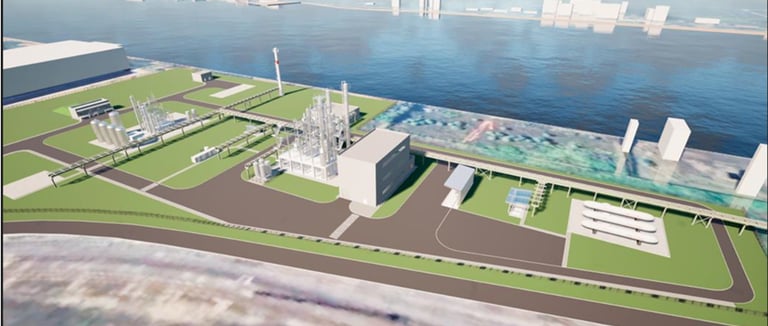
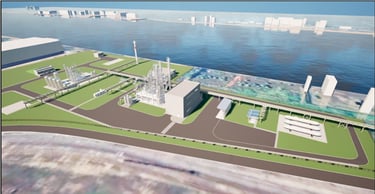
A petroleum terminal operator in Riga's Freeport is now on record with Latvia's State Environmental Service — Valsts vides dienests (VVD) — to build an on-site hydrogen production facility and expand its feedstock options at its SAF and HVO plant currently under construction on Kundziņsala island. The project is SIA PARS TERMINĀLS, and the environmental impact assessment (EIA) decision was issued on 13 April 2026.
We've had this project in our database for some time [LINK TO PROJECT DATABASE ENTRY]. The EIA milestone now brings it meaningfully closer to ground reality — and it raises questions worth unpacking for anyone tracking the Baltic alternative fuels landscape.
From Terminal Operator to Fuel Producer: The Project Background
PARS TERMINĀLS is not a new entrant. The company has operated liquid cargo terminal services at Riga's Freeport for years, handling petroleum products at its Tvaika iela facility and the KS-28 berth on Kundziņsala. What changed in 2024 was a strategic pivot: the company, alongside Ukrainian investors operating under the Amber Flow Fuels joint venture, committed roughly €120 million to build the Baltic region's first industrial-scale SAF and HVO production plant.
The plant's capacity is planned at 236,000 tonnes of feedstock per year, targeting output of approximately 93,000 tonnes of HVO and 87,000 tonnes of SAF annually. Construction is underway following a building permit issued in February 2026. Latvia's Minister for Climate and Energy visited the site in late 2024, calling the facility "an economically forward-looking way to increase Latvia's influence as a sustainable energy producer in the Baltics." airBaltic has been cited as a direct potential beneficiary — particularly relevant as ReFuelEU Aviation mandates are now in effect: 2% SAF at EU airports from 2025, rising to 6% by 2030, with a 1.2% synthetic e-fuel sub-mandate starting from 2030.
The New Layer: On-Site Hydrogen and Waste-Derived Feedstocks
The EIA filed in March 2026 covers two additions to the original plant design.
The first is an on-site hydrogen production module. The approved plant originally assumed hydrogen would be purchased from an external supplier. That assumption has changed: the company now wants to produce hydrogen on-site, citing supply security and operational efficiency as drivers. The EIA evaluates two technology alternatives — steam methane reforming (SMR) using natural gas, and water electrolysis.
The SMR route would involve two parallel production blocks, each capable of up to 7,000 m³ of hydrogen per hour (roughly 0.63 t/h per block), giving a combined annual output of approximately 10,584 tonnes — consumed entirely on-site for hydrogenation, with no external sale or storage. The electrolysis alternative would use grid power, with oxygen either used in-process or vented per regulatory requirements.
The choice between SMR and electrolysis carries significant implications for the carbon profile of the resulting SAF and HVO. SMR hydrogen without carbon capture produces grey hydrogen — compliant for current HVO production but misaligned with the eSAF pathway. Electrolysis powered by renewable electricity produces green hydrogen, which is what qualifies under ReFuelEU's synthetic e-fuel sub-mandate from 2030. The EIA process should clarify which route the company intends to pursue. That's a detail worth monitoring closely.
The second addition is feedstock flexibility. The existing plant is designed around product-grade vegetable oils. The new EIA extends this to include waste-derived plant and animal fats and oils — non-hazardous municipal waste streams including used cooking oils, oil-water separator residues, and washing/cleaning sludges. The maximum annual feedstock volume stays at 236,000 tonnes, but the composition can now shift to include these waste streams in any proportion. The company notes that waste-derived feedstocks carry no additional environmental impact potential compared to virgin vegetable oils.
Location and Permitting Status
The hydrogen module will be installed within the existing Kundziņsala industrial site at Uriekstes iela 30, on land leased from the Riga Freeport Authority. The site is zoned R — industrial construction territory — under Riga's territorial plan, and the Kundziņsala local plan explicitly designates it for port, energy, and heavy industry use.
The nearest residential area — the Kundziņsala housing district — sits approximately 350 metres to the east/northeast, separated from the project site by the TFS Trans logistics terminal. No protected natural values have been recorded on or near the site.
VVD's EIA decision was formally published in the 2 June 2026 edition of Diena. A public consultation meeting is scheduled for 15 June 2026 at 17:30 at Sarkandaugavas community centre "eS14" (Sīmaņa iela 14, Riga), with hybrid format and Zoom access. Written submissions to VVD are open until 25 June 2026.
What This Signals for the Baltic Alternative Fuels Landscape
The PARS TERMINĀLS / Amber Flow Fuels project sits alongside several other active Baltic alternative fuel developments. NorSAF in Liepāja's Special Economic Zone is targeting 100,000 tonnes of SAF annually by 2030, with eSAF capability via green hydrogen and captured CO₂, and CIS Liepāja has entered a cooperation agreement with NorSAF for hydrogen supply. Together, these projects sketch out a meaningful Baltic production base for fuels currently imported in their entirety.
The strategic logic is straightforward. Baltic fuel infrastructure has historically been built for transit and import. Building domestic production capacity — even for biofuels requiring significant hydrogen input — shifts that position. For Baltic hydrogen ecosystem stakeholders, the more consequential question is whether the hydrogen modules supporting these fuel plants can be electrolysis-based and renewable-powered. That's the pathway from biofuel plant to genuine Power-to-X infrastructure.
The PARS TERMINĀLS EIA explicitly keeps both SMR and electrolysis as live alternatives. That design-phase decision is still open — and it's worth watching.
Project in Our Database
We've been tracking the Amber Flow Fuels / PARS TERMINĀLS project since its early development phase. Full project details — including feedstock logistics, technology pathway, regulatory timeline, and offtake context — are available in our project database:
The Amber Flow Fuels 87 kta SAF plant in Freeport of Riga (Latvia)
If you're a developer, investor, or infrastructure provider active in Baltic alternative fuels or Power-to-X and want to discuss what projects alike means for your positioning in the region, use the contact details on our website.