Pilot hydrogen training in Estonia: a practical template for Baltic workforce development
TalTech Virumaa College has launched a pilot hydrogen training course under the H2CoVE project, covering fundamentals across the hydrogen value chain—from production and safety to storage, transport, and applications. It’s a practical workforce-development model that could be replicated across Latvia and Lithuania as Baltic hydrogen projects scale.
NEWS
PtXBaltic
2/3/20262 min read
Hydrogen strategies across Europe increasingly converge on the same bottleneck: skills. Technology roadmaps, project pipelines, and funding instruments move forward—but without a workforce that understands hydrogen’s properties, safety requirements, and real-world applications, deployment slows down.
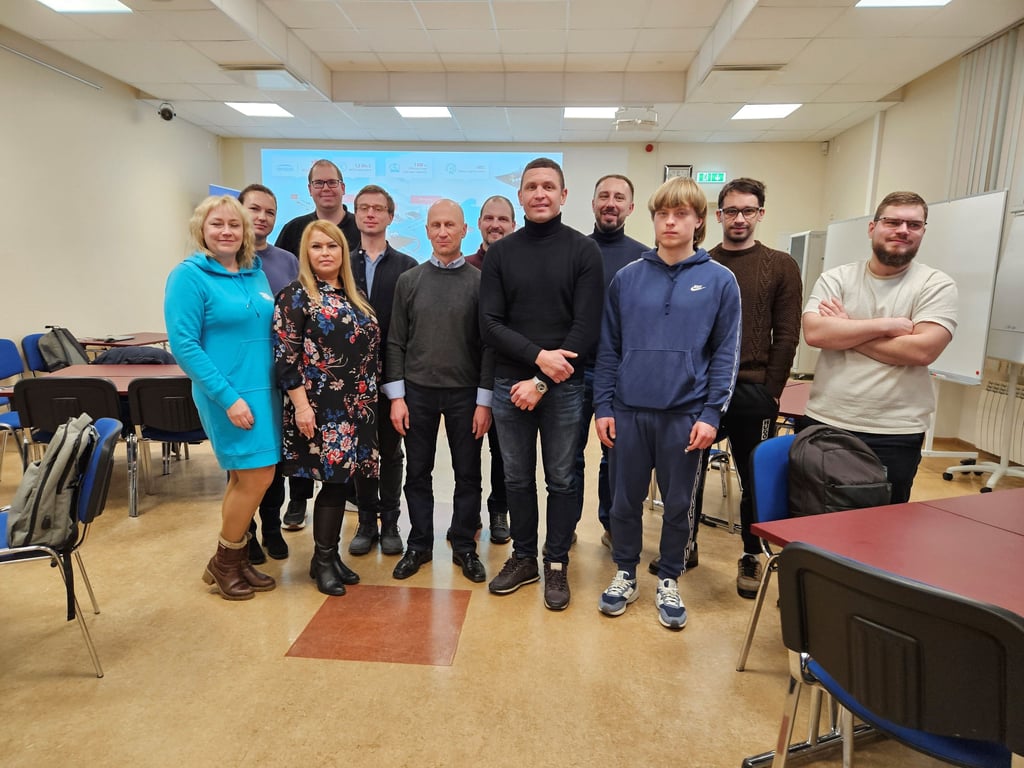
A useful example comes from Estonia. In November 2025, TalTech Virumaa College delivered its first hydrogen-related continuing education course, “Fundamentals of Hydrogen Technologies” (6 ECTS), under the international H2CoVE project. The course introduced participants to hydrogen technologies, the hydrogen value chain, and industrial and energy applications—covering hydrogen’s physical and chemical properties, production pathways, safety, storage, transport, and sector use cases (from mobility to the chemical industry).
Why this matters: training that matches the value chain
What stands out is the course design: it’s explicitly built around the full hydrogen value chain, not a single niche. That’s important in the Baltic context, where emerging projects often require cross-disciplinary competence—engineers and technicians who can connect production choices to storage constraints, safety management, and end-use requirements.
The target group was primarily master’s level learners, but the content is also suitable for bachelor students and engineering professionals. That “mixed audience” approach can be a strength in smaller markets: it helps build a shared baseline across academia and industry, and it accelerates the translation of theory into operational decision-making.
Blended learning + practical relevance
The pilot used a blended format (classroom plus practical component). According to the instructors, participant interest was high and discussion was grounded in practical examples and current technologies—helped by the fact that learners were already connected to technical or industrial fields. In other words, the training wasn’t happening in a vacuum; it was anchored in working-life contexts.
Participants also highlighted two recurring points in their feedback:
the training felt timely and practically relevant
the learning materials and instructor training need continuous updates to keep pace with a fast-evolving sector
That second point is worth underlining. Hydrogen is moving quickly not only technologically, but also in standards, regulation, and safety practice. Treating course content as “living material” is likely a requirement, not a nice-to-have.
What’s next in Estonia (and a signal for the region)
Within H2CoVE, additional modules are planned in Estonia, including: Fundamentals of Hydrogen, Hydrogen Technologies, Hydrogen Safety, Hydrogen Safety Management, Hydrogen Storage Systems, and Hydrogen in Mobility and Industrial Systems. Together, these form a coherent pathway for engineers, vocational learners, and specialists preparing for hydrogen economy roles.
Coordination is led by TalTech Virumaa College in cooperation with Tartu Vocational College (VOCO). Employers are involved both in shaping content and providing practical placements—an important mechanism for keeping training aligned with workforce needs.
An initiative worth replicating in Latvia and Lithuania
For Latvia and Lithuania, this is an initiative worth replicating—not necessarily by copying the exact curriculum, but by adopting the model:
modular training mapped to the hydrogen value chain
blended delivery with practical components
employer involvement and placement opportunities
continuous updates to reflect technology and regulation
As Baltic hydrogen projects move from concept to implementation, workforce development needs to move in parallel. Estonia’s pilot shows a pragmatic way to do that—starting with fundamentals, then building specialized modules that industry can actually use.
Source: TalTech – Pilot hydrogen training courses launched in Virumaa College under the H2CoVE project