The Funding Engine Behind Baltic Power-to-X Is Up for Review — Feedback Closes 14 July
The European Commission is gathering evidence on how future Joint Undertakings — the funding vehicles behind the Clean Hydrogen Partnership — should work under the next EU research programme, and the window closes on 14 July 2026. For Baltic Power-to-X developers whose projects live or die on long-term investment signals, it's a direct line to the people redrawing those signals.
POLICYNEWS
PtXBaltic
7/1/20264 min read
Power-to-X doesn't reward the impatient. Between the first renewable electron and a molecule someone will actually buy, there are years of permitting, engineering, offtake negotiations and financing rounds. And the one thing that whole timeline leans on — more than any single grant — is confidence that Europe intends to keep backing the journey from lab to market.
That confidence is built on instruments most people never stop to think about. One of them is being reopened right now. The European Commission is collecting evidence on the future of Joint Undertakings, and the feedback window closes on 14 July.
What's actually being decided
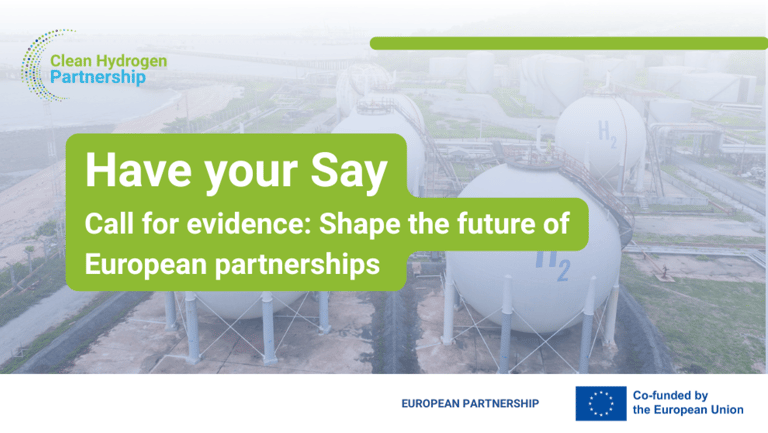
On 29 June 2026, the Clean Hydrogen Partnership pointed its community toward a European Commission Call for Evidence on the future "Single Basic Act for Joint Undertakings." Joint Undertakings are the legal structures that let the EU, industry, research organisations and Member States pool money and commitment behind a shared agenda. The Clean Hydrogen Partnership is one of them.
The question on the table is how these partnerships should be built under the next Horizon Europe framework programme, which runs from 2028 to 2034. The Commission wants input on governance, openness, simplification, private investment, synergies, and support across the full span from early research to investment-ready deployment. What it hears feeds the impact assessment for the legal act expected in the fourth quarter of 2026. Feedback closes 14 July 2026.
Why the model matters for molecules, not just hydrogen
The Clean Hydrogen Partnership has never been only about producing hydrogen. Its remit runs the length of the chain — production, storage, distribution, transport, and the conversion steps that turn renewable hydrogen into the e-fuels and derivatives that decarbonise shipping, aviation and heavy industry. That full-chain scope is exactly what a dedicated partnership protects. A broader, less specialised instrument can lose the thread of a sector where the value only shows up at the end of a long conversion process.
There's a live debate in Brussels about consolidating into fewer, larger partnerships. In the European Parliament, the lead rapporteur on the next framework has argued that partnerships should default to the Joint Undertaking format, echoing the Draghi report's push for scale. I'd flag that these are proposals still moving through negotiation between Parliament and Member States, with final agreement expected only in late 2027 — so nothing here is settled. But the direction of travel carries a real risk for a field like Power-to-X: dilution. The specific, patient support the conversion layer needs can get averaged away inside something bigger. The Commission itself notes that uncertainty around the partnership model can weaken investment signals and slow the move from demonstration to deployment. For PtX, where investment signals are the whole game, that's not an abstract worry.
The evidence the sector can put forward
The Partnership has published a short guidance document with data and arguments stakeholders can adapt. Some of it makes a genuinely strong case for continuity.
Hydrogen Valleys have shown beneficiaries investing around €3.94 of their own money for every €1 of EU funding — a leverage ratio that's hard to argue with. More than 55% of the Partnership's Horizon Europe funding has gone to organisations outside its membership, and SME participation sits above 27%, which counters the usual suspicion that these instruments only serve incumbents. On the technology itself, the Partnership points to electrolyser capacity scaling into the hundreds of megawatts within a decade while costs fell by roughly a factor of ten. These are the Partnership's own figures — the sector's headline case rather than independently audited data — but as an argument for keeping a dedicated instrument, it holds together.
Where the Baltics fit
This isn't a decision being made over the heads of the region. The Baltic states are already inside the Partnership's flagship work. BalticSeaH2 — co-funded through the Clean Hydrogen Partnership — is building a cross-border hydrogen valley that stitches together Estonia, Latvia, Lithuania and six other countries around the Baltic Sea, with the explicit aim of growing integrated value chains rather than isolated production sites. That value-chain logic is Power-to-X logic.
Estonian, Latvian and Lithuanian developers, research institutions, SMEs and public bodies who've worked inside these programmes hold precisely the ground-level evidence the Commission asked for: what the funding model made possible, and where it slowed them down. Consultations that shape EU instruments tend to be dominated by the largest and best-resourced players. The regions that show up get designed for. The regions that stay quiet get designed around.
Making it count before 14 July
The process is refreshingly low-friction. Feedback goes through the European Commission's Have Your Say portal, on the initiative page for European Partnerships to be implemented as joint undertakings. You'll need a free EU Login account. You can respond as an individual or on behalf of an organisation, in any official EU language.
Pair the Partnership's guidance material with something only you can provide — your own project, your own numbers, your own account of what worked and what didn't. That combination is what turns a submission from noise into evidence. The window is short and there's no second one before the impact assessment moves. If the future of Power-to-X funding matters to what you're building in the Baltics, this is a rare moment where a small amount of effort lands squarely where the decisions get made.
Source: Call for evidence: Clean Hydrogen stakeholders invited to have their say