PowerUP’s EDF Wins Put Baltic Hydrogen Fuel Cells on the Strategic Map
PowerUP Energy Technologies’ selection in two European Defence Fund projects is more than a company milestone. It shows how Baltic hydrogen fuel cell innovation is moving from niche promise into strategic applications across defence, off-grid power and resilient energy systems.
NEWS
PtXBaltic
4/16/20263 min read
A strong signal from the Baltic hydrogen market
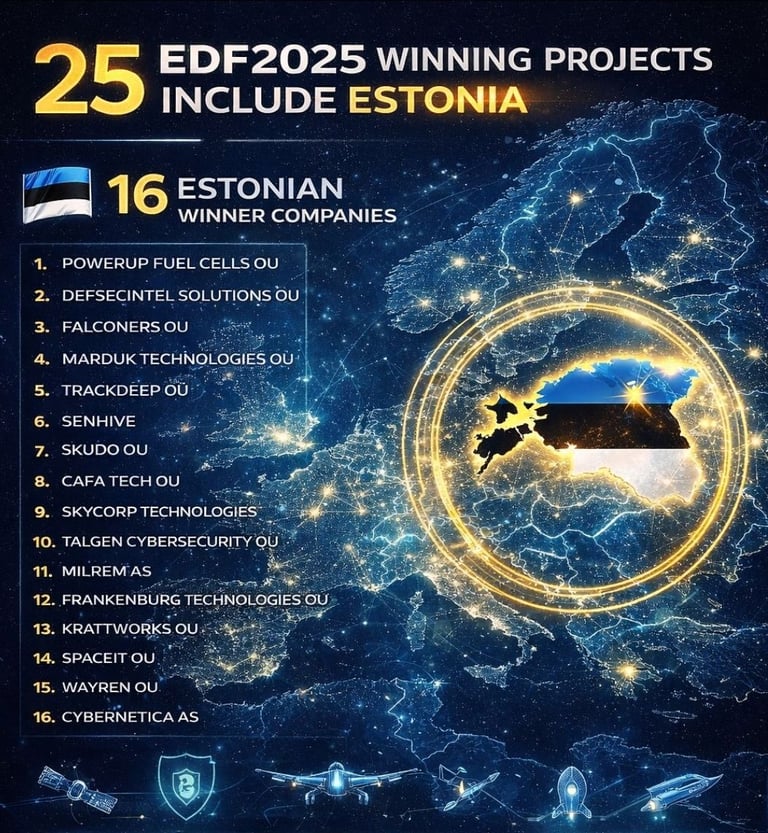
One of the more telling hydrogen stories in the Baltics right now is coming from Estonia. PowerUP Energy Technologies has announced that it secured two European Defence Fund-backed projects, and the official EDF 2025 results published on 15 April 2026 confirm a broad selection round of 57 projects, placing hydrogen-enabled resilience firmly inside Europe’s current defence and technology agenda.
That matters beyond one company. When a Baltic hydrogen technology player appears in two selected research actions in the same EDF cycle, it is a sign that the region is no longer only discussing future potential — it is starting to place concrete technologies into strategic European programmes with real budgets, industrial partners and multi-year execution paths. This is an inference based on PowerUP’s participation in both SOLARES and DEEP-TECH, together worth more than €15.6 million at consortium level.
From backup power to strategic resilience
PowerUP, founded in Tallinn in 2016, develops hydrogen fuel cell-based backup and portable power systems. Its positioning has been consistent: clean, modular and low-maintenance power for applications such as defence, telecom, healthcare and other off-grid or critical-use environments.
That industrial story has already been reinforced by capital and market expansion. In November 2025, the company announced a €10 million Series A round to scale manufacturing and commercialisation of its hydrogen-powered generators, and in March 2026 it moved further into Sweden, Denmark and Norway through a strategic distribution agreement for the Scandinavian market.
Two EDF projects with clear strategic relevance
The first selected action, SOLARES, is a 36-month EDF 2025 research project with an estimated total cost of just under €4.0 million. Its stated objective is to develop a fully autonomous, water-propelled hydrogen ecosystem to provide energy and power for on-field operations.
The second, DEEP-TECH, is also a 36-month EDF 2025 research action, but on a larger scale: about €11.6 million in estimated total cost. Its focus is deep-sea and subsea capability, including relocatable robotic seabed nodes and autonomous underwater infrastructures and base stations.
Taken together, these two projects show something important about where hydrogen fuel cells are finding traction. The value is not being framed in generic energy-transition language alone; it is being tied to endurance, autonomy, logistics reduction and reliable power in environments where conventional fuel supply chains are harder, costlier or more vulnerable. That reading is supported by PowerUP’s own framing around defence, operational resilience and reduced dependence on traditional fuel logistics.
A Baltic technology story with wider commercial reach
It would be too narrow to read this only as a defence story. PowerUP’s commercial narrative already stretches across telecom, healthcare, security, off-grid infrastructure and other applications where silent, emission-free and low-maintenance power can create practical value. Trade with Estonia also describes the company’s solutions as relevant for commercial, maritime and institutional use cases.
For Baltic stakeholders, that is where the story becomes especially relevant. The same technology logic that strengthens field resilience can also translate into backup power for coastal assets, temporary port-side operations, remote infrastructure, maritime support uses and critical facilities where diesel dependency, maintenance burden, noise or indoor-use limitations are becoming harder to justify. This is an inference grounded in the company’s stated application areas and product characteristics.
Why this matters for Baltic hydrogen development
The Baltic hydrogen discussion often leans heavily toward future production, large industrial offtake and export narratives. Those remain important, but this case is a reminder that the market also grows through smaller, high-value applications where hydrogen already solves a concrete operational problem better than incumbent alternatives.
That is a useful message for the regional ecosystem. It suggests that hydrogen progress in the Baltics will not be defined by one pathway alone. It will likely be built through a mix of industrial molecules, local resilience applications, dual-use technology, and modular power systems that can win business in defence, infrastructure and off-grid settings before the larger volume markets fully mature. This is a synthesis based on the company’s current market footprint, EDF project portfolio and post-funding expansion trajectory.
The Baltic market direction is becoming clearer
The headline here is not simply that an Estonian company received recognition. The more important takeaway is that Baltic hydrogen technology is starting to show a stronger commercial and strategic profile at the same time: EU-backed research positioning, private capital for scale-up, and growing access to Nordic markets.
For the wider Baltic market, that is worth watching closely. It shows that hydrogen fuel cells are no longer only part of long-range transition scenarios — in the right applications, they are increasingly part of today’s resilience, security and clean power conversation.
Source: LinkedIn post