
Riga Airport Hydrogen Snow Truck: Baltic Pilot Results
Riga Airport tested a hydrogen fuel cell snow truck this winter under the EU-funded BSR HyAirport project. Inside the Baltic pilot's results and what's next.
NEWS
PtXBaltic
6/30/20264 min read
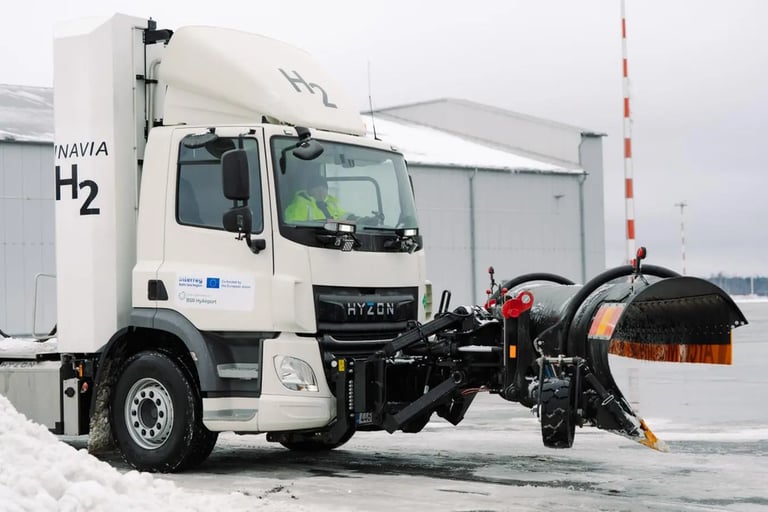
While still challenged by high costs and low availability, green hydrogen is an increasingly viable route to decarbonising industrial processes — and this winter, that route ran straight across the runways of Latvia's largest airport.
Between 16 February and 6 March, RIX Riga Airport put a hydrogen fuel cell truck to work doing something genuinely unglamorous: clearing snow. A Hyzon-built heavy-duty truck, paired with a VAMMAS sweeper-blower attachment, operated on the apron, the taxiways, and the runway under real winter conditions. No demonstration loop, no closed test track. Actual aerodrome maintenance, in the cold, where it either works or it doesn't.
Here's why that matters more than the size of the test suggests.
A real-world test, with real-world numbers
Over the trial period, the truck covered 179 kilometres and consumed 31 kilograms of hydrogen. Those are small numbers, and that's the point — this was a pilot designed to gather operational data, not to decarbonise the whole airfield overnight.
What the test confirmed is significant: hydrogen technology can handle aerodrome maintenance duties in Baltic winter conditions. It also surfaced exactly the kind of limitation you only find by running equipment in the field. When temperatures dropped below minus 10 degrees Celsius, the battery discharged faster than the hydrogen fuel cell could replenish it. That's not a failure — it's the most useful single data point of the entire exercise. You can model cold-weather performance on a spreadsheet for years; one genuinely cold morning on an exposed apron tells you what the spreadsheet missed.
For project developers and operators across the region, that honesty is the value. A pilot that only produced good news would be a marketing event. This one produced an engineering finding.
Part of a coordinated Baltic Sea region effort
The Riga trial wasn't a one-off. The same Hyzon truck has been touring airports across the Baltic Sea region as part of BSR HyAirport — a project whose full name, "BSR Hydrogen Air Transport – Preparation of Baltic Sea Region Airports for Green Hydrogen," tells you exactly where this is heading.
The truck's route reads like a map of regional cooperation. It launched at Helsinki Airport with Finavia in January, ran trials at Kaunas in Lithuania, came to Riga in February and March, and finished at Tallinn — the final stop of the tour. Four countries, one piece of equipment, one shared dataset. Early insights from across the pilots point in a consistent direction: the technology performs well in cold-climate conditions and suits airport-specific operations.
BSR HyAirport runs from November 2023 to October 2026 under the Interreg Baltic Sea Region programme, with a total budget of around 4.8 million euros. It's led by Hamburg Airport and brings together 16 partners — airports, airlines, research institutions, and technology companies from Scandinavia, the Baltic states, Poland, and Germany — alongside 24 associated organisations. The ambition runs well beyond snow ploughs: the project is laying groundwork for airport infrastructure capable of storing, handling, and delivering green hydrogen as a future aviation energy source.
Latvia supplied more than a test site
This is the part that should hold the attention of Baltic hydrogen ecosystem stakeholders. Latvia wasn't just hosting equipment built elsewhere — Latvian institutions are woven into the project itself.
On the Latvian side, the partnership includes the Latvian University of Biosciences and Technologies and aviation fuel supplier SIA "Gulfstream Oil," with national airline airBaltic, Liepāja Airport, the Civil Aviation Agency, and the Ministry of Transport among the associated participants. Riga Airport's own budget within the project sits at roughly 420 thousand euros over the three-year span — a concrete commitment, not a letter of intent.
That spread matters. A national university, the flag carrier, the aviation regulator, the transport ministry, and a second Latvian airport all sitting inside one hydrogen project is exactly the kind of institutional depth a serious energy transition needs. The truck clearing snow at RIX was the visible part. The network of Latvian organisations standing behind the trial is the part that actually compounds.
Pilot scale, but the direction is set
Let's be clear-eyed about what this is and isn't. One truck, 179 kilometres, 31 kilograms of hydrogen, with a documented cold-weather limitation still to solve. This is not the moment Baltic aviation went green. It's a pilot, and it should be read as one.
But pilots are how serious sectors de-risk new technology, and this is what early traction actually looks like — not a ribbon-cutting on a gigawatt electrolyser, but specialised equipment quietly logging hours and generating data that feeds the next decision. Ground support equipment is a smart entry point, too: it's high-utilisation, it returns to a fixed base where refuelling infrastructure can sit, and it operates airside, away from public roads. If hydrogen is going to prove itself anywhere in aviation first, it's here.
The deeper signal for the region is the coordination. Four Baltic Sea countries sharing one test campaign, pooling cold-climate data, and aligning on what comes next is precisely the kind of cooperation the Baltic hydrogen story needs more of. The molecules clearing snow at RIX this winter were a small thing. The infrastructure of trust and shared learning being built around them is not.
For Baltic hydrogen ecosystem stakeholders watching for proof that the region can move from strategy documents to operational reality, this trial is a useful marker. The technology showed up. It did the work. It told us where it still falls short. That's the loop that matures an industry — and for once, Latvia is firmly inside it.
Source: Riga Airport Tests Hydrogen Technologies for Aerodrome Maintenance Operations