From Tartu to Rotterdam: Spiral Hydrogen Takes Its Bubble-Free Electrolyser to Europe's Hydrogen Hub
An Estonian-born deeptech company has planted its flag at Rotterdam's RDM Campus with a bold claim: an electrolyser with no bubbles, efficiency above 90%, and a route to green hydrogen cheaper than the fossil kind. We look at where Spiral Hydrogen came from, how the technology works, and why the cost-parity maths — not the headline — is the story that matters.
NEWS
PtXBaltic
7/13/20265 min read
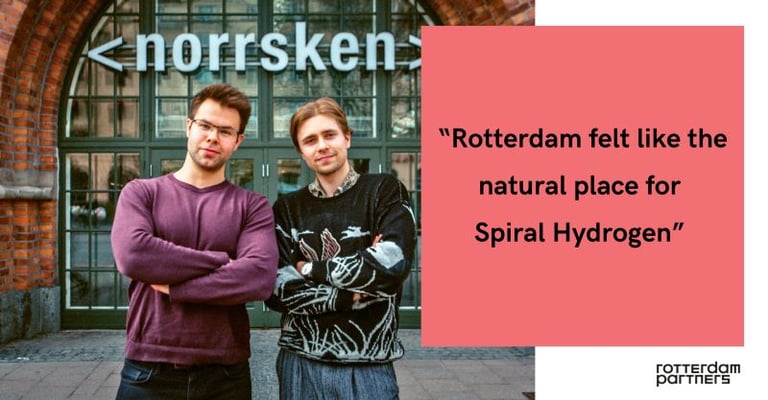
While still challenged by high costs and limited availability, green hydrogen is an increasingly viable route to decarbonising refining, fertilisers, chemicals and heavy transport — if, and only if, somebody closes the price gap with fossil-based hydrogen. In late April, a company founded in Tartu, Estonia announced a €2.7 million pre-seed round to attempt exactly that; in July, Rotterdam Partners publicly welcomed it to the RDM Campus in the Port of Rotterdam. Spiral Hydrogen's journey — from a Baltic university city to Europe's most demanding industrial testbed in under two years — is worth unpacking on two levels: what the technology promises, and what the route it took tells Baltic hydrogen ecosystem stakeholders about how deeptech actually scales.
A Baltic startup, built for a global problem
Spiral Hydrogen was founded in 2024 in Tartu by Juri Volodin and Fedor Stomakhin, a team combining electrochemistry, energy systems and software engineering. From the start the company has carried a dual identity: Estonian by origin and R&D DNA, Dutch by scaling geography, with a base in Delft and now an industrial presence at RDM in Rotterdam. That pattern — Baltic science, Western European deployment — is becoming a recognisable template for the region's deeptech wave, and this is one of its cleaner examples.
The problem it picked is not a niche. Global hydrogen demand runs at roughly 95 million tonnes a year — the company itself points to some 43 Mt consumed by oil refining and a further 55 Mt across fertilisers, plastics and steel — and nearly all of it is still made from fossil fuels. Every tonne of that demand is a decarbonisation opportunity waiting for one thing: a green production cost that doesn't need a subsidy to compete.
The bubble problem: where a third of the energy goes
Conventional electrolysers have a physical flaw hiding in plain sight. As water splits, hydrogen and oxygen form gas bubbles that cling to the electrodes, blocking active reaction sites and forcing the system to push harder for the same output. By the company's account — consistent with the wider literature on alkaline systems — up to 30% of input energy is lost this way, which is a major reason conventional alkaline electrolysers typically operate at 60–70% efficiency.
Spiral Hydrogen's answer is to redesign the cell so bubbles never form. Its centrifugal, bubble-free alkaline electrolyser rotates the electrolyte to keep it in continuous flow, while hydrophobic porous electrodes let the gases pass directly through into dedicated dry gas channels. The rotation does double duty, circulating the electrolyte and carrying heat away without external pumps and separators — fewer components, simpler balance of plant. The company claims efficiency above 90%, and its own materials cite 95% (HHV). A necessary caveat: these are the company's figures from laboratory development, not yet independently validated at pilot scale. That validation is precisely what Rotterdam is for.
Cost parity is the finish line — everything else is a lap time
Why does a ten-to-twenty-point efficiency jump matter so much? Because electricity dominates the levelised cost of hydrogen (LCOH). Every percentage point of efficiency is electricity you don't buy: moving from ~70% to above 90% cuts the energy input per kilogram of hydrogen by roughly a quarter, and in most European power markets that is the single biggest lever on the final price. Spiral's architecture also attacks the other LCOH components — lower CAPEX through fewer external systems, and a design the company argues supports longer stack life.
The strategic logic is stated plainly in the company's own framing: mandates and subsidies help, but only cost parity makes decarbonisation self-sustaining. That is the right frame. Europe's hydrogen ramp-up has been slowed less by ambition than by a stubborn green premium; a technology that closes it at the electrolyser level would change project economics across the board — including for every Power-to-X value chain this publication follows.
€2.7 million, one pilot, a two-year clock
The pre-seed round, announced on 30 April 2026, was backed by Nordic and European investors byFounders, Norrsken Evolve and Superangel, topped up with roughly €0.7 million in grants. The money has one job: take the technology from lab to a working pilot electrolyser in the Port of Rotterdam, built in partnership with SwitcH2, a company specialising in offshore ammonia solutions — a pairing that hints at where bubble-free electrolysis could plug into the e-fuels chain. Completion is expected within about two years, with the pilot intended to validate performance under real industrial conditions and shape a first commercial unit.
Honest sizing is in order: this is pre-seed money and a pilot, not a factory. Nothing here is settled, and the distance from a lab cell to a bankable megawatt-class product has humbled many electrolyser ventures before. But the sequencing — modest capital, industrial partner, real-world site, tight timeline — is the disciplined way to run that gauntlet.
Why Rotterdam — and why Rotterdam wanted them
The landing spot is no accident. RDM — the former Rotterdamsche Droogdok Maatschappij shipyard, reborn as "Research, Design & Manufacturing" — hosts more than 40 innovative companies alongside vocational and applied-science education, with the RDM EnergyLab serving as a dedicated hydrogen hub where students, researchers and entrepreneurs share facilities. Around it sits the full weight of Europe's self-declared hydrogen hub: the port is preparing for roughly 7.4 GW of offshore wind landings by 2032, a national hydrogen backbone is under construction, and electrolyser manufacturing (Battolyser Systems) and hydrogen mobility ventures (zepp.solutions) are already scaling in the same district.
The founders' own reasoning, relayed in Rotterdam Partners' welcome, comes down to proximity — to the port, to industry, to the hydrogen ecosystem, and to people who help make things happen. For a hardware startup, that proximity to offtakers, testbeds and skilled hands is worth far more than cheap rent. Rotterdam, for its part, gets exactly what its testbed strategy is designed to attract: an ambitious technology de-risking itself inside the port's industrial environment.
The efficiency race has more than one runner
Spiral is not alone in the above-90% club's waiting room. Australia's Hysata, which has raised over €150 million, chases the same efficiency frontier with a different architecture (capillary-fed electrolysis), and several other ventures attack the bubble problem from other directions. The comparison cuts both ways. It validates the prize — serious capital agrees that bubble elimination is where the next efficiency leap lives. And it exposes the capital gap: pre-seed versus nine figures is a David-and-Goliath spread, which makes speed to credible, independently verifiable pilot data Spiral Hydrogen's most valuable currency over the next two years.
What this signals for the Baltic ecosystem
Two readings for Baltic hydrogen ecosystem stakeholders. The first is pride with a caveat: a Tartu-founded team has attracted Nordic capital and prime industrial real estate in Europe's largest port — proof the region produces electrolyser science good enough to compete globally. The caveat is that the scaling is happening in Rotterdam, not in Tallinn, Riga or Klaipėda, because that is where the testbed, the offtakers and the ecosystem density are.
The second reading is a to-do list. Baltic ports building their own hydrogen ambitions should study what made RDM the natural landing spot: shared labs, education pipelines feeding technical talent into the district, and a port authority acting as an ecosystem builder rather than a landlord. The talent and the science are demonstrably here. The pilots will go wherever the infrastructure welcomes them — and that is a policy choice, not a law of nature.
Source: Rotterdam Partners — We are excited to welcome Spiral Hydrogen to Rotterdam (LinkedIn)