Estonian Stack Technology Goes European: Stargate and Hydrogenera Sign Framework Deal
Estonia's Stargate Hydrogen and Bulgaria's Hydrogenera have signed a framework cooperation agreement, taking precious-metal-free Baltic alkaline stacks into industrial hydrogen projects across Europe. For the Baltic hydrogen ecosystem, it marks how far home-grown electrolyser technology has travelled.
NEWS
PtXBaltic
7/7/20263 min read
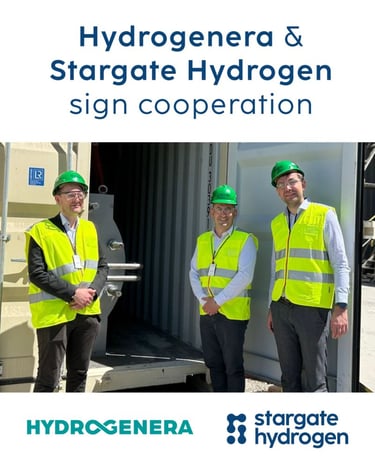
Framework agreements rarely make headlines. They carry no signed project, no capital committed and no plant breaking ground — just two companies agreeing to work together when the right opportunity appears. But the framework cooperation agreement signed in early July between Estonia's Stargate Hydrogen and Bulgaria's Hydrogenera is worth pausing on, because of what it says about where Baltic hydrogen technology now sits. A stack designed and built in Tallinn is being lined up to go into industrial hydrogen systems across Europe — and that is a different kind of marker than another corridor study.
A framework that pairs the stack with the system
The logic of the agreement is complementarity. Stargate Hydrogen supplies its next-generation alkaline electrolyser stacks; Hydrogenera integrates them into complete hydrogen production systems, drawing on its own strength in system design, balance-of-plant engineering, manufacturing and project delivery. Both companies keep operating independently, collaborating only on selected opportunities — industrial hydrogen plants, demonstration projects and consortium bids — with individual contracts, orders and services negotiated separately as they arise.
Described by both sides as more than a memorandum of understanding, it is framed as already moving into concrete cooperation. Stargate's CEO Marko Virkebau said the aim is to make the company's stacks available to system integrators across Europe through partnerships like this one; Hydrogenera's CEO Dragomir Ivanov framed it as combining Stargate's electrolysis expertise with Hydrogenera's engineering, manufacturing and delivery capability. In plain terms: one company makes the core of the electrolyser, the other turns it into something an industrial site can actually run.
Precious-metal-free stacks, and why Europe cares
Stargate's central proposition is a stack design that eliminates the need for precious metals. That is not a minor engineering footnote. Platinum-group metals are expensive, price-volatile and concentrated in a handful of supplier countries, and every electrolyser that depends on them ties Europe's hydrogen build-out to an import it does not control. A stack that removes them lowers production cost and, just as importantly, strengthens the resilience of a European hydrogen supply chain that is still taking shape.
Making that technology available to third-party integrators, rather than keeping it inside Stargate's own product line, widens the route to market. It means the precious-metal-free approach can reach projects Stargate would never build itself — which is precisely the kind of supply-chain deepening the sector keeps saying it needs, and rarely gets.
An Estonian company that has been scaling fast
The partnership lands at a point where Stargate has been moving quickly. Founded in Tallinn in 2021, the company has, according to trade press, opened a 140 MW electrolyser factory in Estonia and drawn a majority investment from Spanish energy group Repsol — a level of backing few Baltic clean-tech firms reach. Alongside that, it has signed cooperation with Nordic developers OX2 and Fortum, produced its first hydrogen at Fortum's Kalla project, opened a first UK partnership, and been reported to be exploring manufacturing in Saudi Arabia.
Read as a sequence rather than isolated announcements, these are the moves of a company maturing from a promising start-up into a genuine European supplier. The Hydrogenera agreement fits that pattern: it is another route to market, this time through a partner's system-integration business rather than Stargate's own sales channel.
What Hydrogenera brings to the table
The other half of the deal matters just as much. Hydrogenera — founded in Sofia in 2016 and previously known as Green Innovation — develops alkaline electrolysers and metal hydride storage, and covers the full chain from technology and system design through to balance-of-plant engineering, integration, manufacturing and industrial deployment. It is not a paper partner: recent work includes an electrolyser deployment at Volkswagen's plant in Poland and a 2 MW unit at a Ukrainian project aiming to export hydrogen to Germany.
That is the credibility the arrangement rests on. Industrial hydrogen projects rarely fail on the electrolyser cell alone; they fail on integration, engineering and delivery into demanding operating conditions. Pairing a lower-cost, precious-metal-free stack with a partner that has actually delivered complete systems is the combination a bankable industrial project tends to need.
What this signals for the Baltic hydrogen ecosystem
A note of realism first: no projects, volumes or figures have been announced, and it would be a mistake to read this as anything more than a framework — a structure for cooperation, not a contract. If it converts into delivered projects, that will be the moment worth celebrating.
But the direction of travel is worth marking now. Baltic hydrogen ecosystem stakeholders can point to an Estonian company whose technology is being pulled into Europe's industrial hydrogen build-out by a partner two thousand kilometres away, on commercial terms. That is a more durable kind of relevance than hosting a pipeline: it means the region is exporting technology and know-how into the European value chain, not just producing molecules at home. For a Baltic PtX sector still turning strategy documents into industrial reality, a home-grown electrolyser maker becoming a supplier others build around is exactly the kind of signal that compounds.
Source: Stargate Hydrogen — Hydrogenera and Stargate Hydrogen sign agreement