The Nordic-Baltic Hydrogen Corridor: why the “market signal” matters now
The Nordic-Baltic Hydrogen Corridor (NBHC) is a ~2,500 km cross-border hydrogen pipeline concept linking Finland, the Baltics and Germany—and it’s now asking the market to signal real interest. Here’s why that non-binding “Call for Interest” matters for turning regional hydrogen projects into a scalable, investable ecosystem.
NEWS
PtXBaltic
1/23/20262 min read
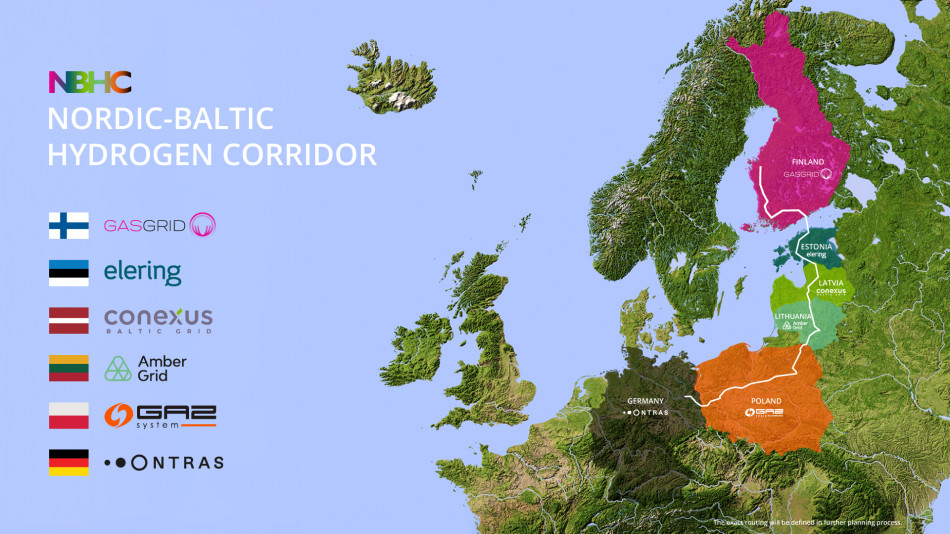
Hydrogen in the Baltics is moving from strategy decks to real infrastructure decisions—and the Nordic-Baltic Hydrogen Corridor (NBHC) is one of the clearest examples of that shift.
A new cross-border hydrogen pipeline concept is being developed to connect Finland, Estonia, Latvia, Lithuania and Germany—linking future hydrogen production, storage options, and end-users into one corridor. The idea is simple: if we want a functioning hydrogen market, we need the physical backbone that allows molecules to move to where they’re needed, when they’re needed.
What is NBHC, in practical terms?
NBHC is a planned ~2,500 km hydrogen pipeline corridor promoted by six transmission system operators:
Gasgrid (Finland)
Elering (Estonia)
Conexus Baltic Grid (Latvia)
Amber Grid (Lithuania)
GAZ-SYSTEM (Poland)
ONTRAS (Germany)
The corridor is designed to support large-scale hydrogen flows across the Baltic Sea region and into Central Europe—helping connect supply (renewables-driven hydrogen production) with demand (industry, refineries, chemicals, e-fuels, heavy transport, and future power balancing).
The project has been recognised as a Project of Common Interest (PCI) by the European Commission and has received up to €6.8m in EU support for its feasibility phase. The ambition often referenced publicly is the ability to transport ~2.7 million tonnes of hydrogen per year by 2040.
The key update: NBHC is asking the market to speak up
Right now, NBHC is in feasibility work—but feasibility isn’t only engineering. It’s also about proving there will be real usage.
That’s why the promoters have launched a non-binding Call for Interest (open 14 January – 31 March 2026) aimed at:
hydrogen producers (current and planned),
potential offtakers (industrial users, mobility, synthetic fuels),
storage and logistics players,
and other stakeholders who would rely on cross-border transport.
This stage is not about signing hard commitments. It’s about building a credible demand/supply picture, understanding route priorities, sizing, phasing, and the commercial logic behind the corridor.
Why this matters for the Baltics
From a Baltic perspective, hydrogen infrastructure is not “nice to have”—it’s what turns projects into bankable investments.
Without transport options:
producers face limited local demand and higher risk,
offtakers face uncertainty on long-term supply and price,
and the region struggles to scale beyond pilots.
With a corridor concept like NBHC:
we can connect Baltic renewable potential with industrial demand across borders,
enable regional hubs and storage strategies,
and reduce fragmentation by aligning standards, planning, and investment signals.
In other words: the corridor is not the end goal—it’s the enabler.
What I’d encourage stakeholders to do
If you’re developing (or considering) hydrogen production, hydrogen use in industry, e-fuels, ammonia, storage, or logistics in the region—this is exactly the moment to engage. Early input is how routes, capacity assumptions, and development priorities get shaped.
If we want hydrogen to become a real part of the Baltic energy and industrial transition, we need both: projects and the connective tissue between them.
Call for Interest is open until 31 March 2026.
(If you’re unsure whether you “fit” as a respondent—my view is: respond anyway. Market clarity is built from many partial signals, not a few perfect ones.)
Source: