Renewable Methanol Comes to Ventspils: Inside Biorefic NRG's 50,000-Tonne Plant and What It Signals for Baltic PtX
A Ventspils developer has filed plans for a renewable methanol plant producing up to 50,000 tonnes a year from local wood residues, RDF, CO₂ and green hydrogen — one of the clearest signs yet that Baltic developers intend to make alternative fuels at home, not import them. We break down what Biorefic NRG is proposing, why methanol is the molecule to watch, and what the project tells the wider Baltic Power-to-X ecosystem.
NEWS
PtXBaltic
6/4/20263 min read
A 50,000-tonne signal from Ventspils Free Port
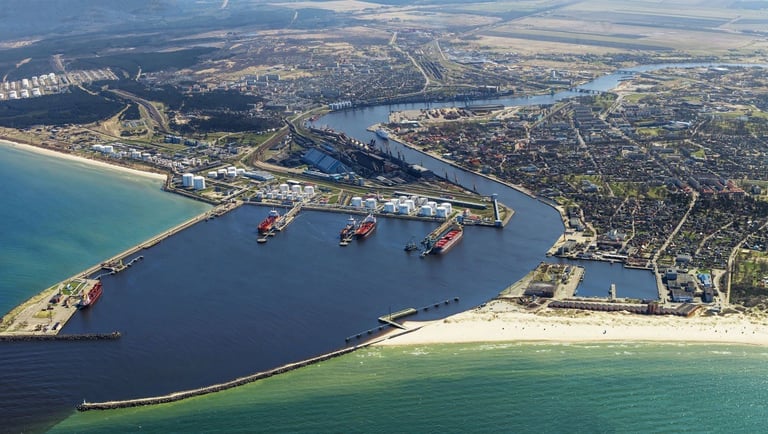
An environmental impact assessment filing rarely makes for exciting reading. But every so often one lands that says more than its paperwork lets on. In April, SIA Biorefic NRG submitted plans to Latvia's Energy and Environment Agency for a renewable methanol plant inside the Ventspils Free Port — and the numbers behind it are worth pausing on.
The plan is to build a facility on industrial plots along Mauru ceļš, producing up to 50,000 tonnes of renewable methanol a year, running close to continuously at up to 8,000 operating hours annually. That is not a pilot. That is a developer planning to manufacture a globally traded fuel and chemical feedstock, on Latvian soil, from materials the region already has.
Three methanol pathways under one roof
What makes the project interesting is that it doesn't bet on a single recipe. Biorefic NRG intends to produce three kinds of methanol from the same site: biomethanol from woody residues, e-methanol from green hydrogen and CO₂, and circular methanol derived from refuse-derived fuel (RDF). One plant, several routes to the same molecule.
The process chain runs from gasification, through syngas cleaning, to methanol synthesis. Green hydrogen feeds the e-methanol pathway, supplied either by an on-site electrolyser or sourced externally. Heat for the process comes from a combustion installation rated up to roughly 100 MW. On the feedstock side, the filing points to around 55,600 tonnes of wood chips, 47,700 tonnes of RDF and 2,900 tonnes of hydrogen per year.
For Baltic hydrogen ecosystem stakeholders, that feedstock mix is the tell. Wood residues and RDF are abundant and local. The chemistry turns a waste-and-byproduct problem into a fuel — which is exactly the kind of integrated thinking the Power-to-X conversation has been pointing toward for years.
Why methanol, and why now
Methanol has quietly become one of the most credible decarbonisation fuels for shipping. The technology is proven — DNV's 2025 Methanol in Shipping report notes methanol-fuelled engines have accumulated well over half a million operating hours, with a track record stretching back roughly a decade. The catch has always been supply. The same report puts current global bio-methanol production at only a small fraction of where demand could sit by 2040.
That gap is where European regulation comes in. FuelEU Maritime, in force since the start of 2025, ratchets down the allowed greenhouse-gas intensity of marine fuel and rewards renewable fuels of non-biological origin (RFNBOs) — e-methanol among them. The direction of travel is set; what's missing is molecules. A plant that can produce renewable methanol at commercial scale in a working Baltic port is aimed squarely at that opening.
The case for Baltic-made fuel
Here's what we read into the Biorefic NRG filing. For most of the energy-transition story, the Baltics have been framed as a place where fuel gets consumed, transported, or — at best — where the renewable electricity gets generated. Production of the finished molecule has tended to happen elsewhere.
A project like this flips that posture. It takes local biomass, local waste streams and locally producible hydrogen, and turns them into a finished, exportable fuel inside a Latvian free port. That is indigenous production in the truest sense — and it speaks to an ambition we're seeing more of across the region: Baltic developers who want to own the value-added end of the alternative-fuels chain, not just feed into someone else's.
Energy independence is usually discussed in terms of electricity and gas. Liquid fuels you can make yourself, from your own residues, belong in that same conversation.
Where the project stands
It's worth being precise about the stage. The Agency's decision, dated 21 April 2026, determined that a full environmental impact assessment is required for the project. That is the start of the formal permitting road, not the end of it — the EIA itself, public consultation, and the various approvals still lie ahead. The nearest protected area, the Platenes purvs nature reserve within the Natura 2000 network, sits roughly 2.6 kilometres from the site, and no protected habitats or species were identified on the plots themselves.
So this is an early-stage signal, not a ribbon-cutting. What we'll be watching: the technology and engineering partners that come on board, where the hydrogen ultimately comes from, and whether offtake — the buyers who'll actually purchase the methanol — gets locked in. Offtake is where projects like this live or die.
What it means for the Baltic PtX ecosystem
One filing doesn't reshape a market. But it does add a concrete, named, scaled project to a Baltic Power-to-X pipeline that has been heavier on strategy documents than on shovels. A 50,000-tonne renewable methanol plant in Ventspils, drawing on regional feedstock and tied to a real demand signal in shipping, is the kind of project the corridor needs more of.
For the developers, investors and offtakers watching this region, the message is straightforward: the ambition to make alternative fuels in the Baltics, from Baltic resources, is moving from slideware toward permitting. We'll keep tracking it.
Source: Atjaunīgā metanola ražošanas rūpnīcas izveide Ventspils brīvostas teritorijā (SIA “Biorefic NRG”)