
Foam Flight: How a Riga Laboratory Became a Reference Point for Hydrogen Aviation
The 2026 Automotive & Aerospace Special Issue of Urethanes Technology International has put a Latvian laboratory at the centre of one of hydrogen aviation's hardest unsolved problems: keeping liquid hydrogen at –253 °C for two decades of service. We look at what earned the Latvian State Institute of Wood Chemistry that interview, why its bio-based polyurethane approach is the difficult route rather than the easy one, and what the story signals for the Baltic hydrogen ecosystem.
INNOVATIONSNEWS
PtXBaltic
7/15/20265 min read
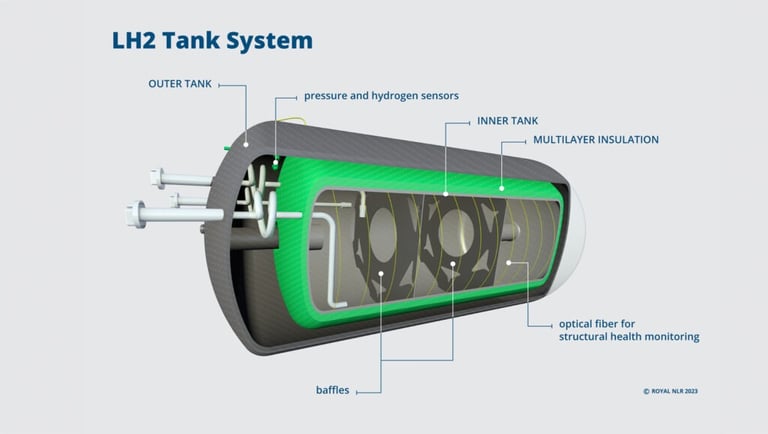
A specialist polyurethane magazine is not where most people go looking for hydrogen news. Yet the 2026 Automotive & Aerospace Special Issue of Urethanes Technology International carries a long feature titled "Foam Flight", and its central interviewee works in a laboratory on Dzērbenes iela in Riga. Industry journalist Steven Pacitti sat down with Uģis Cābulis, scientific director of the Latvian State Institute of Wood Chemistry (LVKĶI), to work through a question the aviation industry has not yet answered: how do you hold liquid hydrogen at roughly –253 °C inside an aircraft, for twenty years of service, without the insulation becoming the weakest link in the fuel system?
A trade journal's aerospace issue is a harder room than a press release
Urethanes Technology International has been published internationally six times a year in print since 1984, under Crain Communications, and it covers the polyurethanes industry for the people who formulate, buy and qualify these materials for a living. It is not a general-interest outlet that can be won over by a good narrative. When that publication devotes a feature in its aerospace issue to a Latvian institute, the signal is technical rather than promotional: the work is considered relevant by the constituency that would have to industrialise it.
This is also not the first time. LVKĶI's Ariane 6 work appeared in the same journal's Summer 2025 issue. Two features in roughly a year, in a magazine read by the global PU supply chain, is a pattern rather than a one-off — and it is worth noticing that the pattern is being set from a country of under two million people, in a materials field with a very short list of credible players.
The interview rests on hardware that has already flown
The reason Cābulis gets asked is that his laboratory has cryogenic insulation in orbit. Since 2005, the Polymer Laboratory at LVKĶI has worked with ArianeGroup in Bremen and the European Space Agency on polyurethane cryogenic insulation capable of withstanding –253 °C. According to the Institute, that material was designed, tested and validated across the full technology readiness ladder — TRL 3 to 9 — and flew on the upper stage tanks of Ariane 6's inaugural launch in July 2024. It is described as one of the first Latvian-developed products to physically reach space, and Latvia has been an ESA Associate Member only since 2020.
That distinction matters more than it might appear. Cryogenic foam has plenty of laboratory literature and very few organisations that have carried a formulation all the way through qualification to flight. Having done it once is no guarantee of doing it again inside a different regulatory regime — civil aviation certification is not space qualification — but it is the difference between a research proposal and a credible one. It is also, in practical terms, what earns you the interview.
The project we covered in June, now seen from the industry's side
We've been following this work. In June we set out the mechanics of PUR4LH2 — Rigid Polyurethane Foam as Cryogenic Insulation for Future Zero-Emission Commercial Aircraft — in detail: the project's structure, its funnel of 70 laboratory systems narrowed to six for pilot-scale optimisation, and why cryogenic insulation is an enabling technology rather than a component. That piece is here: Cryogenic Insulation for Hydrogen Aviation: A Baltic Deeptech Case.
What the Urethanes interview adds is a different vantage point. Our June piece looked at the project from the hydrogen economy's side and asked what it means for the region. Pacitti's feature looks at it from the polyurethane industry's side and asks a narrower, sharper question: can this chemistry actually be made to work? The answer Cābulis gives is not a triumphant one, and that is what makes it worth reading.
Bio-based and bulletproof is the hardest version of the brief
The tension Cābulis addresses in the interview deserves to be stated plainly rather than smoothed over. PUR4LH2 is not simply reproducing space-grade foam for aircraft. It is deliberately building it out of harder ingredients: polyols derived from renewable feedstock and recycling streams — in this laboratory's longer body of work, tall oil fatty acids from wood pulping side streams, alongside recycled PET — with heavy-metal-free catalysts and blowing agents of low global warming potential.
Every one of those choices makes the qualification problem worse before it makes it better. Cryogenic conditions punish variability, and aviation qualification demands properties that are stable and precisely controllable across an entire service life. Renewable feedstocks, by their nature, carry more batch-to-batch variation than petrochemical ones. As Cābulis frames it, the research task is finding the balance between safety, longevity and the use of renewable raw materials — which is a polite way of saying that the sustainable route costs you time, money and margin at exactly the point where an aviation authority is least forgiving.
Taking it anyway is a coherent bet. The EU's F-gas Regulation (2024/573) phases down high-GWP fluorinated gases and brings insulation foams into scope around 2033; a cryogenic foam designed today on low-GWP chemistry is one that does not need re-engineering the moment the regulation bites. And a zero-emission aircraft insulated with high-GWP foam and heavy-metal catalysts would be an awkward object by the time it entered service. The harder path is the one that is still standing at the end.
Twenty years is the number that changes the difficulty
A launch vehicle's insulation performs once. An airliner's insulation must survive thousands of cryogenic cycles, ground time, moisture ingress and ageing, and still deliver predictable numbers two decades later. That single specification — a service life of at least 20 years meeting aviation safety and qualification requirements — reshapes everything upstream of it, and it is why the Ariane 6 heritage is a starting point rather than an answer.
The work that follows is accordingly unglamorous and essential: long-term ageing tests, repeated cryogenic cycling, and methods for detecting and mitigating defects. The team has already published on one specific failure mode — a 2025 paper in Polymers by Yakushin, Dhalivala, Vēvere and Cābulis on how production technology influences cryogenic water uptake in rigid PU foam. Water accumulating in a closed-cell foam under a steep thermal gradient is exactly the kind of problem that only surfaces when somebody insists on measuring it over years rather than minutes.
The timeline caveat that belongs in every honest version of this story
PUR4LH2 was framed around European civil aviation's ambition of a liquid-hydrogen commercial aircraft by 2035. That target has moved. Airbus pushed ZEROe back from 2035 towards the 2040s and cut the programme budget, citing a hydrogen ecosystem developing five to ten years slower than expected; reporting in early 2026 also pointed to certification slippage and workforce reductions at ZeroAvia. Anyone selling hydrogen aviation as imminent is not reading the room.
I'd flag this without treating it as a refutation. Materials qualification is the long pole in this particular tent — a foam that needs a decade of ageing data cannot be started once the airframe is ready. A slower aircraft timeline arguably makes upstream materials work more valuable, not less, provided the funding holds. The risk is not that the research is premature; it is that research budgets follow headlines, and the headlines have turned.
Source: LVKĶI kriogēnās siltumizolācijas pētījumi – starptautiska nozares žurnāla fokusā